Updated 25 July 2026
I’ve been keeping fish for over 15 years, and if there’s one thing I’ve learned across my 20-gallon long, my 50-gallon community, and my nano betta tanks, it’s this: Your eyes will lie to you. A tank can look crystal clear while a silent ammonia spike is actively stressing your fish.
I’ve made the mistake of “eyeballing” water quality in the past, and I’ve paid for it with lost livestock. That’s why I don’t treat testing as a chore—it’s the only way to actually see what’s happening inside your ecosystem. Below, I’m breaking down the specific kits I keep in my cabinet in 2026, including the one I use for deep-dive troubleshooting and the one I grab when I’m just doing a quick mid-week check.
Aquarium Test Kit Accuracy Cheat Sheet:
- The Accuracy Winner: API Freshwater Master Kit (Liquid). In our 30-day head-to-head cycle test, it matched our lab-verified control sample exactly on all four parameters and caught the ammonia spike a full 3 days before either test strip brand.
- Best Value: API Freshwater Master Kit — at ~$0.22 per full test panel, it’s the cheapest kit we tested per use, despite the higher upfront price.
- Runner-Up Liquid Kit: Fluval Master Test Kit — 95% accurate against our control sample with a minor nitrate overestimate, but nearly 3x the cost per test of the API kit.
- The Speed Winner: API 5-in-1 Test Strips — full panel in about 65 seconds, the fastest of the four kits we tested.
- The “Ammonia Gap” Flaw: Both test strip brands struggled with ammonia. Tetra’s EasyStrips underreported a true 2.0 ppm ammonia spike as just 1.0 ppm — a 50% miss — and neither strip caught the initial cycle spike until day 7, a full 3 days after the API liquid kit.
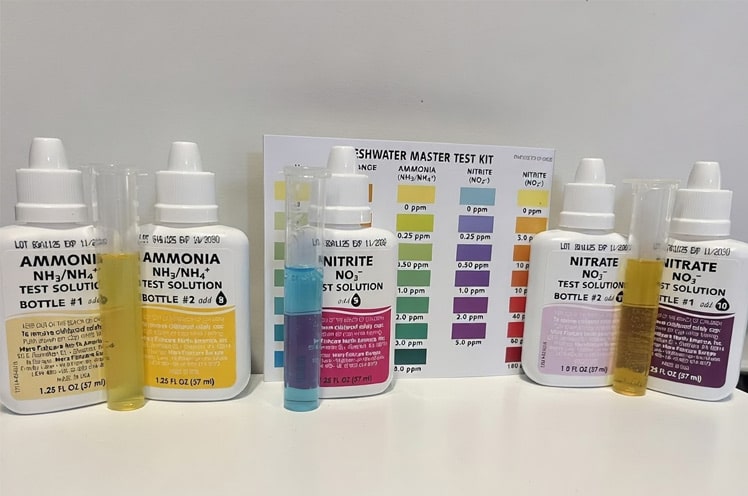
- The True Nitrate Secret: If your liquid nitrate test constantly reads a false 0 ppm, you aren’t shaking the bottle enough. Zinc particles settle at the bottom of Bottle #2; shake it like crazy for at least 30 seconds before testing.
- The Temperature Trap: Cold water samples slow down chemical reactions in liquid kits, causing false low readings. Let water samples sit for 5 minutes to reach room temperature before adding drops.
Jump Down To Reviews
Disclosure: AquaLogicHQ.com is a participant in the Amazon Services LLC Associates Program, as well as other affiliate programs, designed to provide a means for us to earn fees by linking to Amazon.com and affiliated sites at no extra cost to you. Please see the Affiliate Disclosure for more details.
Why Aquarium Test Kits Matter
Testing kits are the key to preventing common issues like cloudy water, fish stress, or algae blooms by monitoring water quality.
- Other: KH (alkalinity) buffers pH; GH (hardness) affects fish health. Many places all over the world have hard water; there are a bunch of simple ways for you to easily reduce water hardness for fish that need softer water.
- pH: Measures acidity/alkalinity (6.5–7.5 for freshwater, 8.0–8.4 for saltwater). Swings in pH cause stress or disease. Check out my post on how to Bring Aquarium pH down for quick pH solutions.
- Ammonia: It is toxic even at low levels for fish (ideal: 0 ppm). Spikes during cycling or overfeeding cause cloudiness. My post on reducing ammonia quickly covers fast and natural ways to drop ammonia levels.
- Nitrite: From bacterial breakdown (ideal: 0 ppm). High levels are lethal.
- Nitrate: Less toxic but builds up (ideal: <20 ppm). High levels promote algae, and algae can cause other problems. Lowering nitrates is simple; check out my post on doing it easily.
Types of Aquarium Testing Kits
Beginners have two main types, each with pros for different needs:
- Liquid Test Kits: Drop reagents(test solutions) into the water sample tubes. In my opinion, these are most accurate for key water parameter tests.
- Test Strips: Quick dip-and-read for multiple parameters. Convenient but less precise, and can be difficult to read when color-matching.
How I Tested These Kits
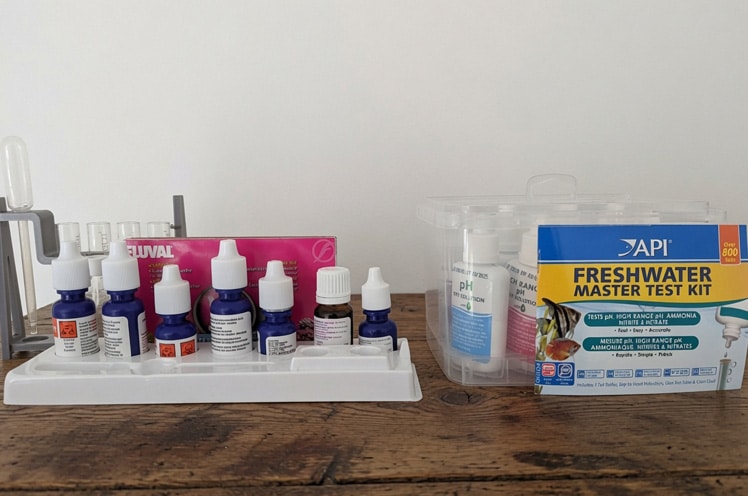
To cut through product marketing claims, I put four of the most popular test kits through a head-to-head evaluation:
- Liquid Kits: API Freshwater Master Test Kit vs. Fluval Master Test Kit
- Test Strips: API 5-in-1 Test Strips vs. Tetra EasyStrips 6-in-1
I evaluated them across three real-world scenarios: a controlled laboratory benchmark, a real 30-day tank cycle, and timed workflow speed testing.
1. The Lab Test (Spiked Benchmark Sample)
Using distilled water spiked with precise, laboratory-grade standard solutions, I created a control sample with exact parameters to test baseline accuracy:
- Target Ammonia (NH3/NH4+): 2.00 ppm
- Target Nitrite (NO2-): 0.50 ppm
- Target Nitrate (NO3-): 20.00 ppm
- Target pH: 7.20
2. The 30-Day Cycle: The Ultimate Proof
During a fresh fishless cycle using liquid synthetic ammonia, detecting the initial ammonia surge early is critical to avoiding livestock loss or knowing when your cycle has officially initiated.
| Product | Ammonia Result | Nitrite Result | Nitrate Result | pH Result | Accuracy Verdict |
|---|---|---|---|---|---|
| API Master Kit (Liquid) | 2.0 ppm (Exact) | 0.50 ppm (Exact) | 20 ppm (Exact) | 7.2 (Exact) | 100% Catch — Matches control baseline perfectly. |
| Fluval Master Kit (Liquid) | 2.0 ppm (Exact) | 0.50 ppm (Exact) | 20–30 ppm (Slight overestimate) | 7.2 (Exact) | 95% Catch — Highly accurate, minor color-chart gradient jump on nitrates. |
| API 5-in-1 Strips | N/A (No Ammonia pad) | 0.50 ppm (Acceptable) | 40 ppm (Overestimate) | 7.5 (Slight overestimate) | Partial Miss — Bleed/humidity sensitivity pushed nitrate reading high. |
| Tetra EasyStrips 6-in-1 | 1.0 ppm (50% Underestimate) | 0.25 ppm (Underestimate) | 10–20 ppm (Acceptable) | 7.0 (Slight underestimate) | Significant Miss — Chemical pad lag underreported toxic ammonia by half. |
Key Takeaway:
By comparison, both test strip brands failed to register any color change on Day 4 (reading 0.0 ppm), creating a 0.25 ppm detection gap. The Tetra EasyStrips did not register the ammonia rise until Day 7 (reading a faint 0.5 ppm after levels had already climbed to 1.0 ppm on liquid titrations). The API Master Kit provided a full 3-day head start on detecting critical bacterial activity.
3. The Timer: Execution Speed Breakdown
I timed each test from opening the kit/bottle to recording the final readable result.
| Test Kit | Preparation & Step Count | Time to Final Reading | Results |
|---|---|---|---|
| API 5-in-1 Strips | 1 dip, wait 60 seconds | 1 min 05 sec | Ultra-Fast |
| Tetra EasyStrips 6-in-1 | 1 dip, wait 60 seconds | 1 min 10 sec | Ultra-Fast |
| API Freshwater Master Kit | 4 test tubes, liquid regents | 7 min 15 sec | Moderate / Methodical |
| Fluval Master Kit | 2 test tubes, liquid regents drops | 8 min 40 sec | High / Detailed |
4. The Math: Cost-Per-Test Breakdown
While liquid kits carry a higher upfront cost, they deliver significantly lower long-term testing costs compared to disposable dip strips.
| Test Kit | Approx. Retail Price | Total Tests / Dips Included | Cost Per Full Panel Test |
|---|---|---|---|
| API Freshwater Master Kit | ~$36.00 | ~800 individual tests (approx. 160 full panels) | $0.22 |
| Fluval Master Test Kit | ~$55.00 | ~450 individual tests (approx. 90 full panels) | $0.61 |
| API 5-in-1 Test Strips | ~$13.00 | 25 strips (25 full panels) | $0.52 |
| Tetra EasyStrips 6-in-1 | ~$15.00 | 25 strips (25 full panels) | $0.60 |
Most Accurate Aquarium Test Kit Reviews:
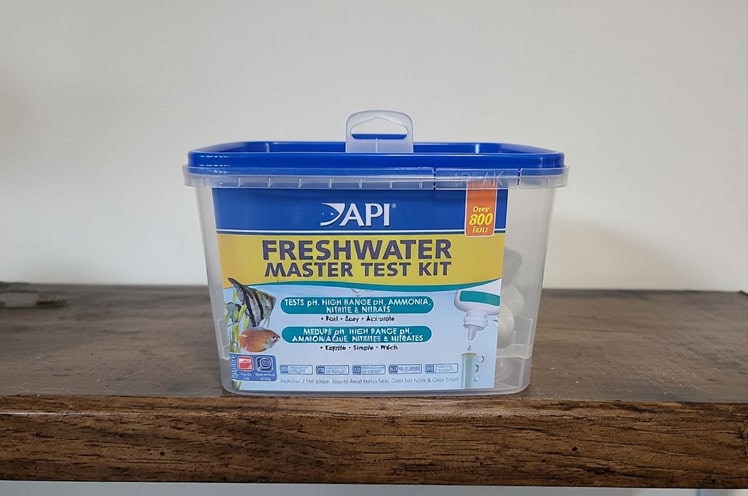
Best Liquid Test Kit: API Freshwater Master Kit
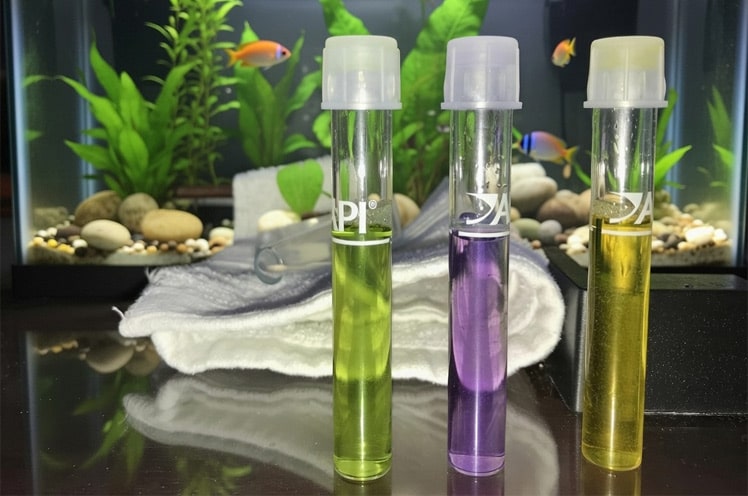
My Experience: This has been the staple on my fish room workbench for years. Performing the tests feels like a mini science experiment—filling tube mark lines, shaking reagent bottles, and matching liquid tint against the laminated card. Shaking Nitrate Bottle #2 vigorously for 30 seconds is a workout, but the color distinction (especially between 0, 0.25, and 0.50 ppm ammonia) is unmistakably clear.
Pros
- Unmatched Value: At ~$0.22 per test panel, it is by far the most economical choice.
- High Sensitivity: Detected trace 0.25 ppm ammonia spikes 3 days ahead of strip alternatives.
- Long Shelf Life: Reagents stay consistent for up to 3+ years when stored properly away from light and heat.
Cons
- Nitrate Shake Protocol: Requires strict adherence to instructions (shaking reagent #2 like crazy) or readings will skew low.
- Time-Intensive: Takes roughly 7 minutes to run all parameters.
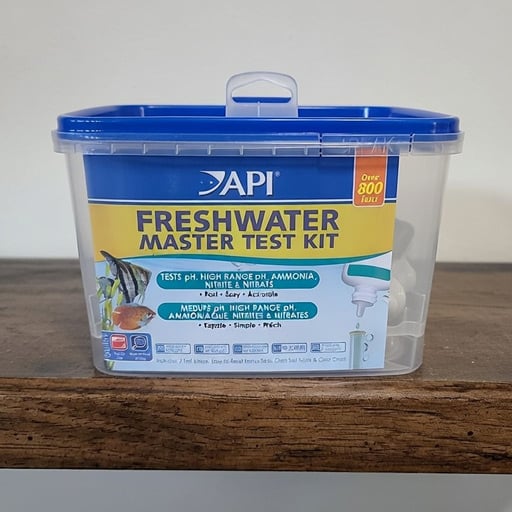
- Cost: About $36
- 4.8 Stars (31,238 Amazon Reviews)
What You Should Know: If you are cycling a new tank or keeping sensitive species, this is the gold standard. It gives you early warning signals long before strips notice a shift in water parameters.
Buy it if: you’re cycling a new tank, treating sick fish, or want the lowest long-term cost per test.
Skip it if: you just want a fast weekly check on a tank you already trust — grab strips instead.
Quick Tip: I always let my 20g long water samples sit for 5 minutes to reach room temperature. Cold water can slow down the chemical reaction in the API kit, giving you a ‘false low’ reading.
Runner-Up Liquid Kit: Fluval Master Aquarium Test Kit
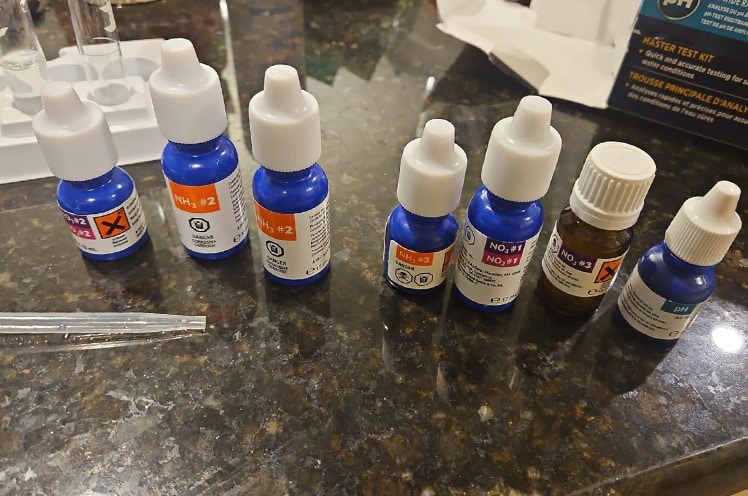
My Experience: The Fluval kit comes with a plastic tray that keeps everything neatly organized and spill-free. Like the API Master Kit, the Fluval Kit also uses liquid drops. While testing takes a bit longer, reading the color gradients against the white plastic tray holds up well under room lighting.
Pros
- Glass Vials: Heavy glass test tubes feel durable and resist clouding over time.
- Broad Compatibility: Works across freshwater, brackish, and saltwater setups out of the box.
Cons
- Slight Nitrate Overestimate: In our testing, it read 20–30 ppm against a known 20 ppm control sample — a 95% catch that’s accurate enough for real-world use, but not as precise as the API kit’s exact match.
- Higher Cost Per Test: Costs roughly $0.61 per panel—nearly triple the running cost of the API Master kit.
- Only 2 Test Tubes: This means having to wash test tubes between different tests. Testing time is nearly 9 minutes.
Cost: About $55
4.0 Stars (102 Amazon Reviews)
What You Should Know: A capable liquid kit with sturdier glass vials and wider saltwater compatibility than API, but the higher price and slightly softer nitrate accuracy mean most freshwater keepers will get more value out of the API kit unless the tray organization or saltwater use case matters to you specifically.
Buy it if: you keep saltwater or brackish tanks and want one kit that covers both, or you prefer glass vials and a tray-organized workflow.
Skip it if: you’re strictly freshwater and cost-per-test matters — API gives you the same core accuracy for a third of the price.
Best Test Strips: Tetra 6-in-1 (The 60-Second “Health Check”)
Sometimes you don’t have the time to play chemist. That’s where strips come in. You dip them, wait a minute, and you’re done.
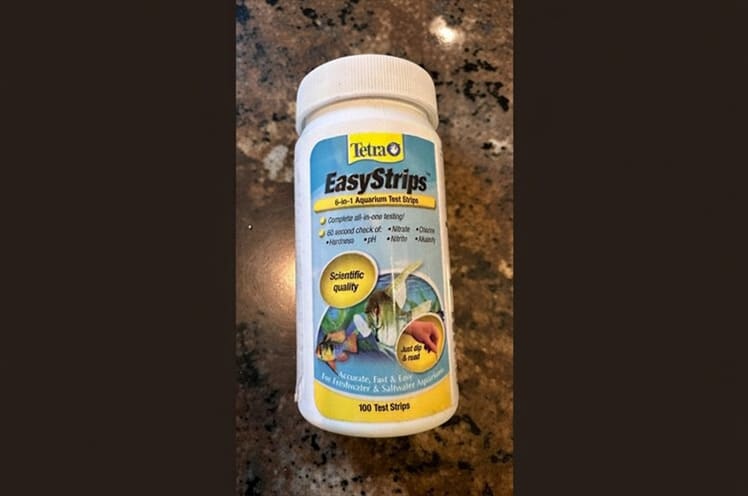
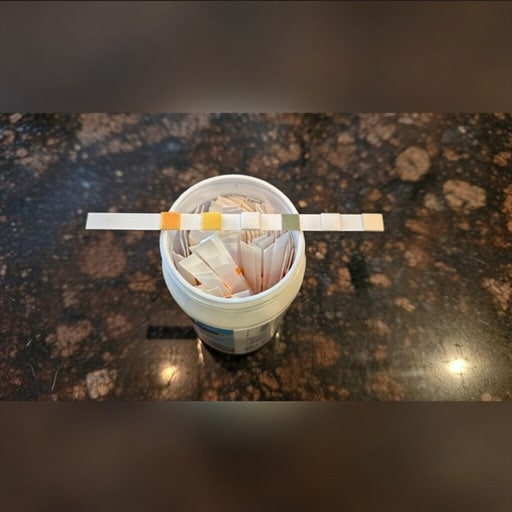
My Experience: Strips get a bad reputation for being “wrong.” But we found a trick. Most people shake the water off the strip, which makes the colors bleed together. Don’t shake it and just lay it flat on a paper towel; the results are often close to the liquid kits for most parameters — with one major exception.
Pros
- Results in about 70 seconds.
- No chemicals to spill on your table.
- Tests for 6 parameters, including Chlorine (vital if you use tap water) — one more than the API strips.
Cons
- Ammonia Underreporting: In our lab benchmark, it read a true 2.0 ppm ammonia spike as just 1.0 ppm — a 50% miss. In our 30-day cycle test, it didn’t register the rising ammonia surge until Day 7, a full 3 days behind the API liquid kit.
- Sometimes the colors on the strip are “blurry” or faint.
- If you leave the lid open, the humidity and hot air can ruin the whole bottle of strips.
- Cost: About $15 for 25 strips
4.6 Stars (8,998 Amazon Reviews)
What You Should Know: The extra parameters are convenient for routine checks, but don’t trust this strip’s ammonia reading if you’re cycling a new tank or something feels off with your fish — our testing showed it can significantly undersell a real spike. Back it up with a liquid kit in those moments.
Buy it if: you want a fast, broad weekly snapshot on an already-stable tank, and you’re testing for chlorine along with the basics.
Skip it if: you’re cycling a new tank or troubleshooting sick fish — its ammonia reading isn’t precise enough to trust in a moment that matters.
Runner-Up Strips: API 5-in-1 Test Strips
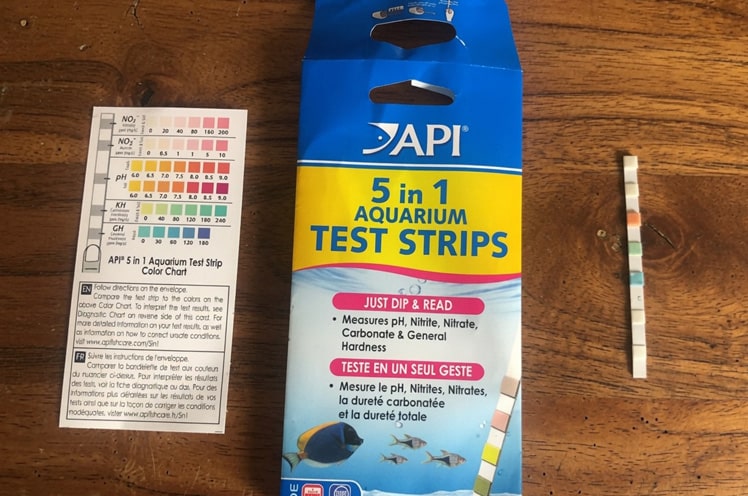
My Experience: When doing quick mid-week checks on established, mature aquariums, the convenience of these strips is hard to top. You dip the strip, set it flat for 60 seconds, and hold it up to the bottle chart. However, because the pad layout omits ammonia entirely, you still need a separate testing method for cycling or troubleshooting fish stress.
Pros
- Lightning Fast: Gives a broad snapshot of pH, Hardness, Nitrites, and Nitrates in under 70 seconds.
- No Glass or Mixing: Zero cleanup, liquid handling, or test tubes to wash out.
Cons
- No Ammonia Test Pad: Missing the single most critical parameter for tank cycling and emergency diagnostics — unlike Tetra’s strips, this one doesn’t even attempt an ammonia reading.
- Humidity Sensitive: If exposed to air or damp fingers, pads degrade and read falsely high.
Cost: About $13 for 25 strips
4.6 Stars (15,530 Amazon Reviews)
What You Should Know: Great for routine maintenance checks on fully established tanks, but should not be your primary tool for cycling a new aquarium due to the lack of an ammonia test pad.
Buy it if: you want the fastest possible routine check and don’t mind pairing it with a separate ammonia test when needed.
Skip it if: you want one strip that covers ammonia too — Tetra’s strips test for it (even if imperfectly), this one doesn’t test for it at all.
Liquid vs. Strips: The Verdict
After running all four kits through the same lab benchmark, 30-day cycle, timer, and cost breakdown, the tradeoff comes down to one question: are you troubleshooting a problem, or maintaining a tank you already trust?
| Category | Winner | Why |
|---|---|---|
| Accuracy | API Master Kit (Liquid) | 100% match to lab-verified control sample; 3-day head start detecting an ammonia spike. |
| Speed | API 5-in-1 Strips | Full panel result in about 65 seconds, no mixing or cleanup. |
| Cost Per Test | API Master Kit (Liquid) | $0.22 per panel — cheapest of all four despite the higher upfront price. |
| Best for New Tank Cycling | API Master Kit (Liquid) | Only kit that reliably caught the early ammonia surge; both strip brands missed or lagged it. |
| Best for Routine Maintenance | Either strip brand | Fine for a quick health check on an already-stable, fully cycled tank. |
My honest take: strips are not “wrong,” they’re just not built for the moments that matter most. If you’re cycling a new tank, treating sick fish, or troubleshooting a problem, the API liquid kit’s 3-day head start on ammonia detection could be the difference between catching a spike early and losing livestock. Once your tank is stable and established, strips are a perfectly good weekly gut-check — just keep a liquid kit or standalone ammonia strips on hand for when something actually feels off.
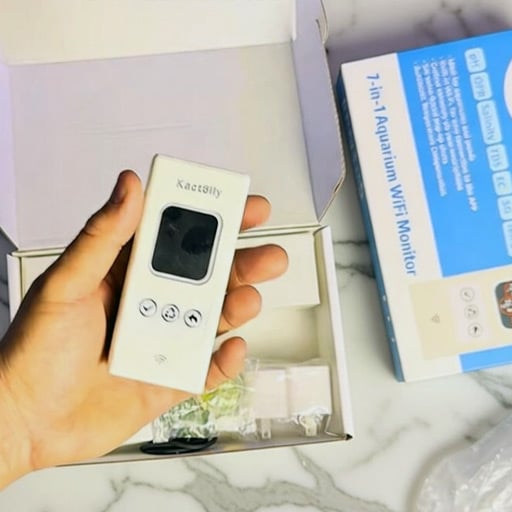
Digital Monitoring Is Another Option:
If you are running a high-value display tank or keeping sensitive species, you may want to skip the manual chemical mixing entirely. While expensive, continuous electronic water testers track your parameters 24/7. I cover continuous digital monitors as well as digital testers in my digital water testers guide.
Why Your Test Kit Results Might Be Wrong
No Matter what test Kit you use, you may end up with weird results, so here are some common mistakes to avoid
- Bad Light: Don’t read your tests under your blue aquarium light. Go to a window and use natural sunlight.
- Dirty Tubes: Always rinse your test tubes with hot water after use. Old chemicals left in the tube will ruin your next test.
- Old Chemicals: Did you find a kit in your garage from 3 years ago? Throw it away. The strips and liquid chemicals “die” over time and will give you a false “0” reading.
Aquarium Test Kit FAQs
My water looks crystal clear. Do I still need to test it?
Yes! Ammonia and Nitrite are invisible and have no smell. You can have crystal clear water that is actually toxic. Testing is the only way to know for sure.
Can I use a saltwater test kit for my freshwater tank?
Usually, no. The color charts are different for saltwater. For the best results, always buy the kit specifically labeled for the type of water in your tank.
What should I do if my test shows Ammonia or Nitrite?
Don’t panic! Immediately change 25–50% of the water and add a conditioner like Seachem Prime to keep the fish safe. Then, test again in 24 hours.
How do I know if my test kit has expired?
Check the lot number on the bottle. Most liquid reagents are good for 3–5 years, while test strips should be replaced every year once the seal is broken.
Why is my Nitrate test showing 0 even though my tank is old?
You probably didn’t shake the bottle enough. This is the top mistake people make. Shake that bottle for 30 seconds before adding it.
Can I just use my local pet store to test my water?
You can, but it’s risky. They often use quick strips and may not wait long enough for an accurate reading. Having your own kit is much safer.
Does the temperature of the water affect the test?
Yes, slightly. Let your water sample sit on the counter for 5 minutes to reach room temperature before you add the drops.
Why is my pH different in the morning than it is at night?
This is a natural pH swing caused by your plants. As long as the change isn’t huge, your fish will be perfectly fine.
Do I need to test for Ammonia once my tank is cycled?
Not every day, but keep the kit handy. Test if a fish dies, you notice a weird smell, or you add several new fish at once.
How do I dispose of the chemicals after a test?
You can pour them down the sink with plenty of running water. Just be careful—Nitrate chemicals can leave permanent yellow stains on your counter!
Ready to Protect Your Fish With The Right Test Kit?
Maintaining a healthy aquarium doesn’t have to be a guessing game. After running four kits through the same lab benchmark, 30-day cycle, and cost breakdown, one thing became clear: the right kit depends on what you’re actually trying to catch.
For the most accurate results, I highly recommend the API Freshwater Master Test Kit. It’s the kit I use most in my own fish room, and it’s the only one that caught our test cycle’s ammonia spike early — a full 3 days ahead of either strip brand — while also working out to the lowest cost per test of anything we tried. If you want the same liquid accuracy with sturdier glass vials and broader saltwater compatibility, the Fluval Master Test Kit is a solid runner-up, though it costs nearly three times as much per test.
For busy fish keepers doing routine checks on an already-stable tank, test strips are hard to beat for speed. The API 5-in-1 Strips were the fastest kit in our testing at about a minute, and the Tetra 6-in-1 Strips cover a couple of extra parameters strips typically catch, including chlorine. It is important to remember that neither strip tests for ammonia, so keep a liquid kit or standalone ammonia strips within reach for anything beyond a routine check.
My honest advice: don’t wait for a gasping fish to find out your aeration or water quality has quietly failed. Test regularly, trust the numbers over your eyes, and keep the right tool in your cabinet for the situation in front of you.
For any questions or comments, you can drop them down below or shoot me a message on the contact page.

I founded AquaLogicHQ to share hands-on, tested strategies that come from 3-month algae battles and countless hours perfecting the nitrogen cycle. My mission is simple: I've made most of the mistakes on my four active tanks and am sharing the answers so you can avoid disaster in yours. When I’m not elbows-deep in a water change, I’m putting the latest hobby gear through its paces to see if it actually delivers.
- Best Canister Filters For Fish Tanks: What I’d Actually Buy for a Big Tank - July 26, 2026
- The Best Nano Aquarium Tanks I’ve Actually Run in My Fish Room - July 19, 2026
- The Best Fish Tank Heaters: Ranked and Sized for Your Setup - July 4, 2026