Updated 25 June 2026
I view water hardness as the “DNA” of your tank. While beginners obsess over pH, veterans know that GH and KH are the real drivers of long-term fish health. After 15 years of keeping everything from soft-water Tetras to hard-water Cichlids, I’ve lived in cities where the tap water was essentially “liquid rock.” In this guide, I’m breaking down the “Mineral Soup” of your water and sharing the methods I actually use to tame it safely, without turning your aquarium into a fragile science experiment.
The TLDR For Reducing Aquarium Water Hardness
- General Hardness (GH): Measures dissolved calcium and magnesium ions. Think of high GH as “liquid rock” water that makes it difficult for soft-water fish to breathe and regulate osmotic pressure.
- Carbonate Hardness (KH): Measures your water’s buffering capacity. High KH acts as a rigid shield that locks your pH in place, causing chemical pH acidifiers to completely fail.
- Method 1 — RO/Distilled Blending: Mixing 50% tap water with 50% RO or distilled water during your regular water change lowers both GH and KH safely.
- Method 2 — Natural Tannins (my preferred way): Driftwood, peat moss, or Indian Almond Leaves soften water gradually while adding a natural look to the tank.
- Method 3 — The Emergency Pillow: A short-term fix for a sudden hardness spike, not a long-term solution.
- The Safe Speed Limit: Never reduce your general hardness by more than 2 degrees of hardness (dGH) in a single 24-hour window. Dropping it faster causes fatal osmotic shock to your fish’s cells.
- The Hardscape Trap: You cannot soften water if your tank features Seiryu Stone, Limestone, or Crushed Coral. These materials actively bleed calcium carbonate back into the water column, causing an automatic hardness rebound.
| Method | Best For | Price | |
|---|---|---|---|
| Mopani Driftwood | Natural, gradual softening with a “tea tint” aquascape look | $16–$30 | Check price |
| Fluval Aquatic Peat | Aggressive natural softening for stubbornly hard tap water | $23 | Check price |
| Indian Almond Leaves | Softening without the dark “tea tint” of driftwood | ~$6 | Check price |
| API Water Softener Pillow | Emergency, short-term fix for a sudden spike | ~$8 | Check price |
Disclosure: AquaLogicHQ.com is a participant in the Amazon Services LLC Associates Program, as well as other affiliate programs, designed to provide a means for us to earn fees by linking to Amazon.com and affiliated sites at no extra cost to you. Please see the Affiliate Disclosure for more details.
The Mineral Soup In Your Tank (GH vs. KH Made Simple)
Before we fix the water, you need to know what we’re actually fighting. Most beginners get confused by the letters GH and KH, but it’s simpler than you think.
General Hardness (GH): Your Water’s “Liquid Rock” Factor
Think of GH as the “thickness” of your water. It’s the total amount of calcium and magnesium dissolved in it.
If your GH is too high, it’s like your fish are trying to run a marathon while wearing a winter coat. It’s hard for soft-water fish to “breathe” and regulate their bodies through their skin and gills when the water is packed with minerals.
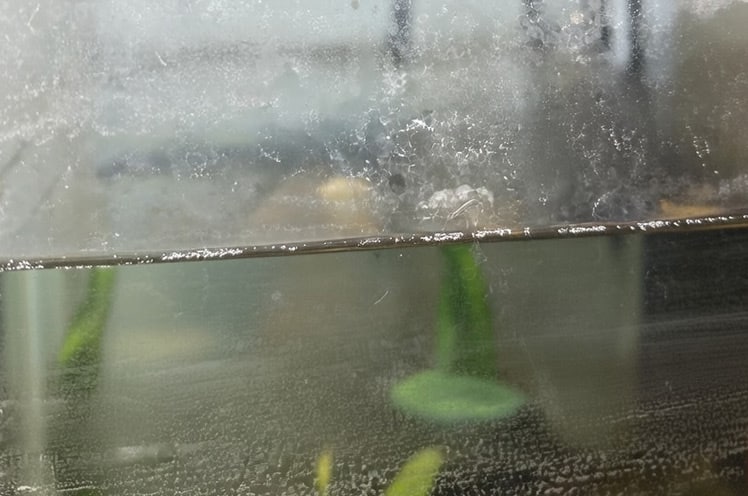
If you are facing foggy white mineral dust alongside high hardness, check out my guide on how to make fish tank water clear easily.
Carbonate Hardness (KH): Your pH Shield
KH measures the “buffers” in your water.
KH is what keeps your pH from swinging up and down. High KH means your pH is “locked” in place. That’s usually great for stability, but it’s a total nightmare if you are trying to lower your pH. You have to lower the KH first, or your pH won’t budge.
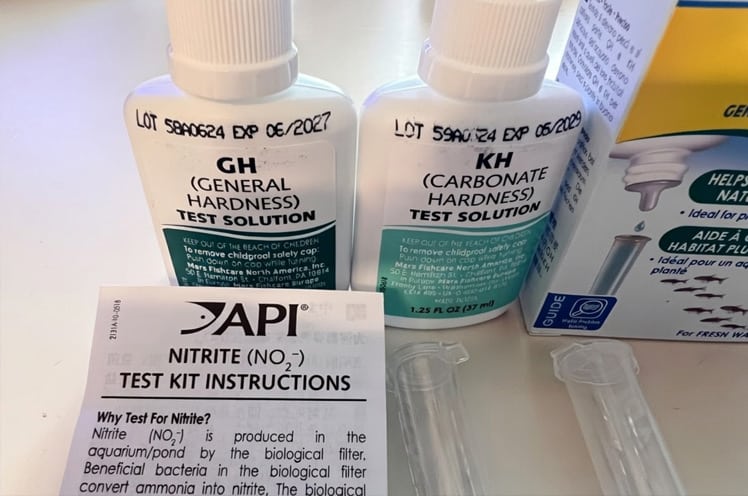
You can use test strips to get a general level of GH and KH, but using a liquid test Kit is BEST!
What’s Your Real Target? GH Ranges by Fish Type
Before you start diluting, dosing, or adding driftwood, ask yourself one question: do you actually need to change anything? Not every fish wants the same water. A target that’s perfect for a Discus could be borderline reckless for a livebearer, and chasing an arbitrary “ideal” number for fish that are already happy where they are is how people accidentally stress out a healthy tank.
Here’s the range I aim for with the species I personally keep, plus the general consensus for other common community fish:
| Fish / Inverts | Target GH (dGH) | Notes |
|---|---|---|
| Discus | 2–6 | Wild-caught need it very soft; captive-bred are more flexible but still prefer soft |
| Tetras (Neons, Cardinals, etc.) | 2–8 | Naturally soft-water Amazon species |
| Bettas | 4–10 | Adaptable, but avoid pushing either extreme |
| General community tropicals | 6–10 | The “sweet spot” most all-around tanks land in |
| Livebearers (Guppies, Mollies, Platies) | 10–20+ | Actually do better in harder water—don’t soften their tank |
| African Cichlids (Rift Lake) | 12–20+ | Need hard, mineral-rich water—softening will stress them |
| Caridina Shrimp (Crystal Red, Bee) | 3–6 | Need soft, stable water—usually remineralized RO |
| Neocaridina Shrimp (Cherry, Blue Dream) | 6–8 | Actually prefer moderate-hard water—don’t over-soften |
If your current GH already falls inside the range for your fish, you’re done — skip straight down to “Don’t Chase the Dragon” below. If it doesn’t, that’s when it’s worth picking a method from the guide and working your way toward the target gradually, not all at once.
Step-by-Step Guide: How I Soften My Tanks
Method 1: The 50/50 Dilution (easiest for everyone)
This is exactly how I maintain my 50-gallon community tank.
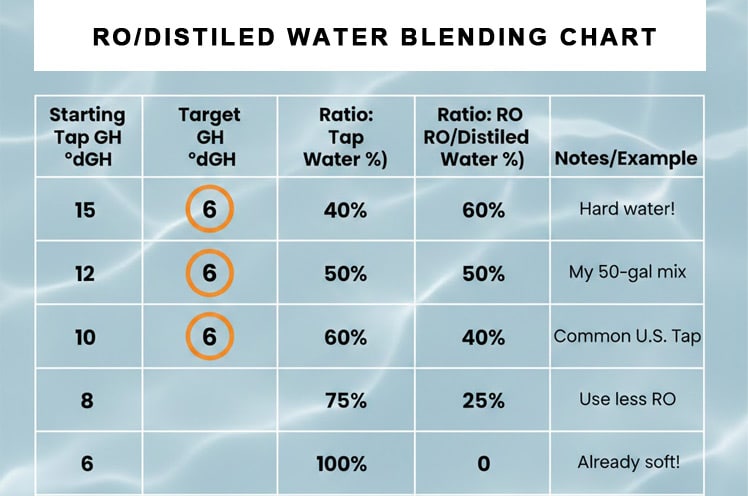
- Test your tap: My tap water usually comes out at 12 dGH.
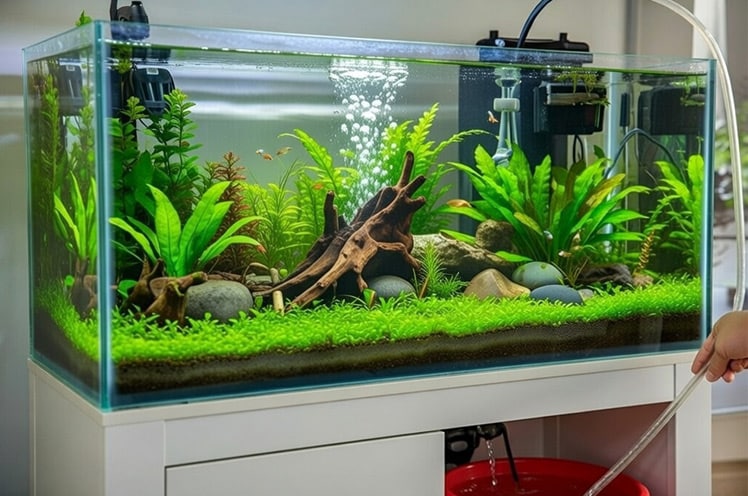
- The Mix: During my weekly 20–25% water change, I mix 50% tap water with 50% Reverse Osmosis (RO) or distilled water in my bucket, bringing that replacement water down to about 6 dGH.
- The Result: Since I’m only replacing 20–25% of the tank at a time, this doesn’t drop my whole tank to 6 dGH overnight — it nudges the average down by about 1–1.5 dGH each week, safely under the 2 dGH “Speed Limit” I cover below. After roughly 8–10 weeks of consistent changes, my tank settles in at that 6 dGH “sweet spot” for good.
- Cost: Under $5 per gallon of distilled water
- Where to get it: Almost any grocery store
You don’t need 100% RO water to get results. I call this “Cutting the Deck” — whatever percentage of RO or distilled water you mix in, you cut that replacement water’s hardness by roughly that same percentage. My tap comes in at 12 dGH, so a 50/50 mix gets my replacement water to 6 dGH. If your tap reads higher or lower than mine, adjust the ratio accordingly. Just remember: it’s the size of your water change, not the dilution ratio, that controls how fast your tank’s overall hardness actually drops — keep changes in the normal 20–25% range, and you’ll stay well under the safe speed limit automatically.
Going Near-100% RO? Don’t Skip Remineralizing
If you’re keeping Discus, Caridina shrimp, or another species that needs water on the very soft end of the GH table above, you might be tempted to skip the 50/50 blend entirely and run close to pure RO or distilled water instead. Be careful here — 0 GH water is not “extra safe”; it’s actually dangerous on its own.
Pure RO water has zero buffering capacity, which means your pH has nothing holding it stable — it can swing wildly with even small amounts of waste or CO2, sometimes crashing overnight. It also strips out trace minerals your fish and plants need to function, not just the ones causing your hardness problem in the first place.
The fix is simple: remineralize before it touches your tank.
A product like Seachem Equilibrium adds back the calcium, magnesium, and trace elements RO water is missing, letting you dial in a specific, stable GH instead of just guessing with straight RO. Test your remineralized water with your liquid kit before adding it to the tank — don’t eyeball the dose.
Method 2: Natural Tannins (My preferred way)
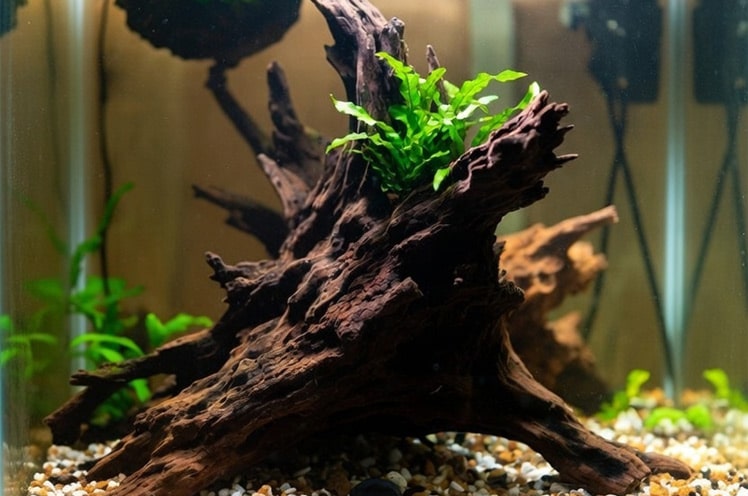
In my 20-gallon long planted tank, I prefer a more natural approach using Mopani Driftwood, though there are other options below. I’ve been using Mopani specifically for its dense tannin release.
- How I use it: Before going into my tank, I boil it to kill bad bacteria, then let it pre-soak in a separate bucket for a few days. This lets the wood release its heaviest tannins into the bucket water first, rather than dumping a sudden flood of tint into my tank. Once the soak water turns noticeably tea-colored, I move the wood into the tank, where it’ll keep releasing tannins at a much gentler, more gradual pace.
- What to expect: Over several weeks, the natural driftwood’s tannins will naturally soften up your tank’s water. It will give your water a slight “tea” tint, which looks incredible in a natural aquascape.
- Cost: 2 to 4.5 Inch (Pack of 10), about $16
6 to 10 Inch (Pack of 3), about $20
9 to 14 Inch (Pack of 2), about $25
13 to 17 Inch (Pack of 1), about $30 - 4.2 Stars (8,501 Amazon Reviews)
If you use driftwood or peat to soften your water but hate the tea-colored tint, you can combine botanical natural softening with Seachem Purigen to keep the water soft and crystal clear.
Softening your water often leads to a drop in pH. If you are keeping sensitive species, read my guide on Lowering pH Safely to ensure you don’t trigger a dangerous acid swing while you soften the water.
Other Natural Aquarium Water Softeners
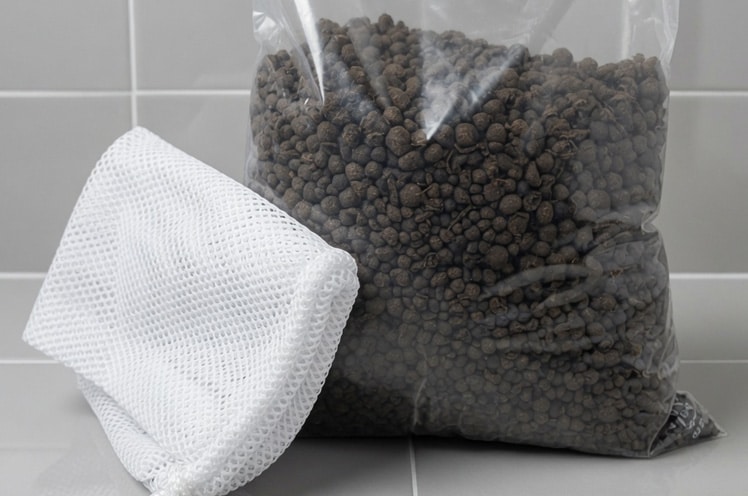
Peat Moss: You can place a mesh bag of aquarium-safe peat in your filter. This is the most “aggressive” natural method and will lower GH and KH effectively, but can darken the water significantly. All-natural peat moss is best, but it can make a real mess. Fluval’s Aquatic Peat makes everything easier, for me anyway, because they are granules I can drop in my filter. Just know you’ll have to get your own mesh bag.
Cost: $23.00
4.4 Stars (2,298 Amazon Reviews)
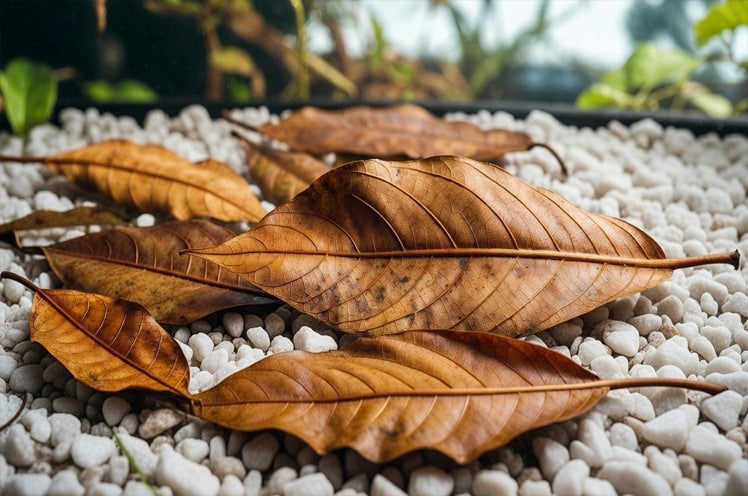
Indian Almond Leaves (Catappa): Many people want soft water but don’t want the dark “tea” color that driftwood produces. These leaves still release tannins, but the tint is far lighter and more gradual than driftwood — which is why they work well for softening water in my nano betta setups without dramatically darkening the tank. They’re also great for the antibacterial properties they add to the water.
How I Use Indian Almond Leaves To Reduce Hardness: Rinse 2 medium-sized leaves for every 10 gallons and drop them into the water. It may take a couple of days before they sink. After a month or so, when they break down, add a few more.
- Cost: About $6
- 4.5 Stars (2,878 Amazon Reviews)
Method 3: The “Emergency” Pillow (Short-Term Fix)
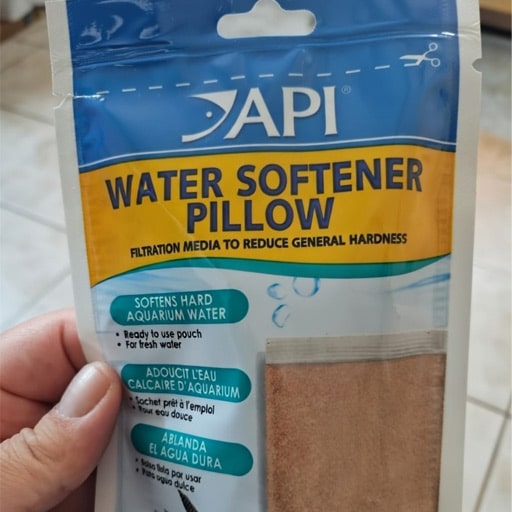
If you need a quick fix, the API Water Softener Pillow is a lifesaver.
- Pro-Tip: I only use these for short bursts (24-48 hours) to bring down a spike. They work by exchanging calcium/magnesium ions for sodium ions.
- Quick Warning: Don’t leave them in forever — too much sodium is a problem for your plants, and it’s just as hard on shrimp and snails, who rely on stable calcium levels for healthy molting and shell growth.
- Cost: About $8
- 4.2 Stars (3,437 Amazon Reviews)
Check Your Substrate And Decor
You can spend all day trying to soften your water, but if you have Seiryu Stone, Texas Holy Rock, Limestone, and/or crushed coral in your tank, you’re fighting a losing battle. These rocks are made of calcium carbonate and will slowly ‘bleed’ minerals back into your water, constantly pulling your hardness back up. If you’re serious about soft water, stick to inert rocks like Lava Rock or Dragon Stone.
Quick Tip: Not sure if a rock you’re considering will harden your water? Do the quick “Acid Test.” Put a few drops of white vinegar on the rock — if it fizzes, it contains calcium and will leach minerals into your tank. I always do this before adding any new hardscape to my setups when I’m not sure.
I learned the hard way and fought hard water for so long without realizing I put the problem in the tank.
A Quick Warning: Don’t Chase the Dragon
Here is the most important thing I can tell you: Stability is more important than “perfect” test results.
If your fish are healthy, eating, and active, but your GH is a little higher than the recommended levels, I say, leave it alone. Fish are incredibly good at adapting to your local water.
The Danger Zone: If you try to lower your hardness too fast, you risk ‘Osmotic Shock.’ Research confirms sudden osmotic shifts cause measurable damage to fish gill tissue and metabolic stress. Never drop your hardness by more than 2 degrees in a single day. Slow and steady wins the race. Think about it this way: it’s better to have hard water than shocked or dead fish.
Frequently Asked Questions: Hard Water Edition
Can I just boil my water to make it softer?
Absolutely not. This is a dangerous myth. Boiling water makes the steam leave, but the minerals stay behind. This actually concentrates the minerals, making your water even harder than it was before.
Does an air stone lower water hardness?
No. Air stones add oxygen and help with surface agitation, but they don’t have any effect on the mineral content (GH) of your water.
Why does my hardness go UP between water changes?
This is the Evaporation Trap. When water evaporates from your tank, only the H2O leaves. The minerals stay behind. If you just top off your tank with tap water every week without doing a proper water change, you are constantly adding more minerals to a shrinking amount of water. This makes your hardness skyrocket over time.
Will aquarium salt make my water harder?
Yes. Salt is a mineral. If you are already struggling with Liquid Rock, adding salt will push your TDS (Total Dissolved Solids) even higher. Use it sparingly!
Can I use the water from my dehumidifier to soften my tank?
The answer is a hard no. First, the cooling coils inside a home dehumidifier or air conditioning unit are often made of bare copper or aluminum. As condensation forms on them, the water leaches toxic trace metals that will instantly kill shrimp, snails, and sensitive fish. Second, a dehumidifier tank is a stagnant breeding ground for airborne mold spores, dust particles, and household bacteria. Stick to pure distilled jugs or a dedicated under-sink RO system—it is never worth risking your fish to save a few cents.
Does API pH Down also lower my water hardness?
Not really, and this is a trap many beginners fall into. pH and Hardness are related, but they aren’t the same thing. If you have high KH (Carbonate Hardness), it will buffer the water, meaning it will fight the pH Down chemicals. You’ll find yourself dumping half a bottle in just to move the needle, only for the pH to bounce right back up the next day. Fix the hardness first, and the pH will follow.
Why does my water hardness stay high even after using driftwood?
Driftwood is a slow-burning solution. It’s not going to change your water chemistry overnight. If you have Liquid Rock tap water (GH 15+), a single piece of driftwood is like throwing a glass of water at a house fire — it’s just not enough. You usually need to combine driftwood with the 50/50 Dilution method (using distilled/RO water) to see a real difference.
Is softened water from a home water softener safe for fish?
This is a tricky one. Most home water softeners work by replacing calcium and magnesium with sodium (salt). While this makes your water soft for your skin and hair, it can actually be harder on your fish because it jacks up the salinity and the TDS. If you have a home softener, I recommend taking your aquarium water from an outside tap or a bypass faucet that isn’t connected to the softening system.
Check Out The Rest Of The
Water Quality & Testing
Proven fixes for ammonia spikes, cloudy water, and pH and other issues.
Conclusion: How to Reduce Water Hardness in Your Aquarium
Softening your water doesn’t have to be a battle against nature. For everyday maintenance, the 50/50 Dilution method or leaning on natural tannins will get you there safely — and if you ever get hit with a sudden spike, the Emergency Pillow is there as a short-term bridge, not a permanent fix. The logic is simple: test first, adjust slowly, and always prioritize stability over perfection. Are you stuck with stubborn “liquid rock” tap water? Drop your GH/KH readings in the comments, and I’ll do what I can to help you troubleshoot it.

I founded AquaLogicHQ to share hands-on, tested strategies that come from 3-month algae battles and countless hours perfecting the nitrogen cycle. My mission is simple: I've made most of the mistakes on my four active tanks and am sharing the answers so you can avoid disaster in yours. When I’m not elbows-deep in a water change, I’m putting the latest hobby gear through its paces to see if it actually delivers.
- Best Canister Filters For Fish Tanks: What I’d Actually Buy for a Big Tank - July 26, 2026
- The Best Nano Aquarium Tanks I’ve Actually Run in My Fish Room - July 19, 2026
- The Best Fish Tank Heaters: Ranked and Sized for Your Setup - July 4, 2026