Updated 26 June 2026
I’ve spent 15 years learning that a stable pH is far more important than a “perfect” one. High pH was one of the first major hurdles I faced in my 50-gallon community tank, and the hard lesson I learned is that you can’t fight chemistry with shortcuts. In this guide, I’m breaking down the logical steps to safely lower your aquarium pH using the same natural and mechanical methods I use in my own fish room today.
How to Lower Aquarium pH TLDR
- The #1 Chemical Trap: Avoid household vinegar or lemon juice. They lack buffering capacity and cause a massive, dangerous pH “yo-yo” effect.
- The Fastest Method: The Fastest Method: RO (Reverse Osmosis) or Distilled Water Dilution. Mixing 50% distilled water with your tap water during each water change gradually lowers both your pH and water hardness — typically settling at a new stable level within about two weeks of consistent changes, without the shock of trying to force it faster.
- The Best Natural Method: Mopani Driftwood or Indian Almond Leaves. These slowly release organic tannins that lower pH safely over several weeks without chemical spikes.
- The Hidden Filter Fix: Tuck a small mesh bag of aquarium-safe Peat Moss into your filter basket for a steady, natural downward buffer.
- The Emergency Rule: Never lower your pH by more than 0.2 to 0.3 units in a 24-hour period. Dropping it faster will shock your fish’s gills and can cause sudden death.
| Natural Methods | Best For | Price | |
|---|---|---|---|
| Mopani Driftwood | Gradual, natural pH drop with an aquascape look | $16–$30 | Check price |
| Indian Almond Leaves | Faster tannin release, great for shrimp/fry tanks | ~$6 | Check price |
| Fluval Aquatic Peat | Hidden filter-basket fix, no visible clutter | ~$23 | Check price |
| Emergency Methods | Best For | Price | |
|---|---|---|---|
| API pH Down | Fast emergency fix directly in tank | ~$5 | Check price |
| Seachem Acid Buffer | Emergency water change additive | ~$12 | Check price |
Click Here To Jump To Emergency Fixes
Disclosure: AquaLogicHQ.com is a participant in the Amazon Services LLC Associates Program, as well as other affiliate programs, designed to provide a means for us to earn fees by linking to Amazon.com and affiliated sites at no extra cost to you. Please see the Affiliate Disclosure for more details.
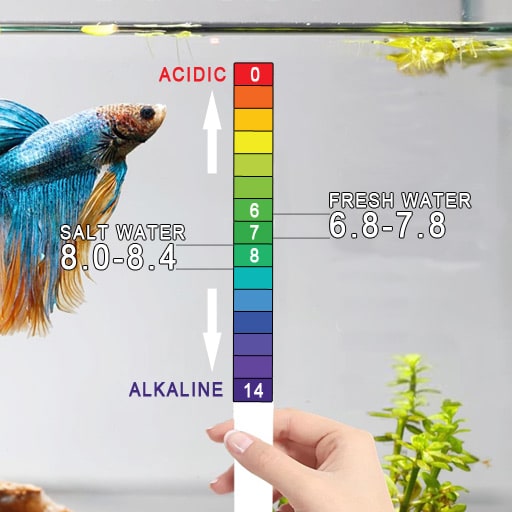
Why Aquarium pH Matters & Common Causes of High pH
pH measures acidity/alkalinity (0–14 scale, 7 neutral). Most freshwater fish thrive at 6.8–7.8. pH swings stress them out, weaken immunity, or cause issues like fin rot.
High pH (>8.0) often comes from:
- Tap water (many municipal supplies 7.8–8.5 due to minerals). Make sure you test your tap water!
- Substrates like limestone/coral gravel. These substrates look great, but may cause problems in the long run.
- Low CO2 (from over-aeration or few / no plants). I was so scared to add live plants because I thought they would cause me headaches, but the exact opposite happened. Adding live plants to my tanks has helped so much in keeping water levels stable.
My local tap water often hits 8.0+ on the pH scale, so before adding it to my tanks, I run it through the same RO/distilled mix I cover below — that way I’m never dumping straight 8.0 water on my fish and hoping for the best.
Ok, now that we’ve got all the background info out of the way, let’s get into why you’re here… How to bring aquarium pH down!
Case Study: The “pH Rebound” Mystery in My First 10-Gallon
When I started my first 10-gallon tank, I was obsessed with getting a “perfect” 7.0 pH for my Neon Tetras. My tap water was a harsh 8.2, so I bought a bottle of pH Down and started adding it daily.
The Problem: Every morning, I’d test the water, and it would be right back at 8.2. I thought the test kit was broken! I kept adding more chemicals, and the constant “yo-yo” effect stressed my fish so much that they stopped eating and hid behind the filter.
The Discovery: I learned about KH (Carbonate Hardness). My tap water was so full of minerals that it acted like a spring, pushing the pH back up as soon as the chemicals wore off. I was fighting a losing battle with chemistry.
The Fix: I stopped the “bottled fixes” and switched to a 50/50 mix of RO (Reverse Osmosis) water and tap water. This lowered the “buffering capacity” naturally. Within two weeks, the pH settled at a stable 7.4.
The Lesson: A stable 7.4 is always better than a pH that bounces between 7.0 and 8.0 every day. If your pH won’t stay down, stop dosing and start looking at your water hardness (KH) instead.
What is pH Rebound?
If you use a chemical acidifier and see your pH return to its original high level within 24 hours, you’re experiencing pH Rebound. The cause is almost always KH (Carbonate Hardness) — your water’s buffering capacity. Carbonate and bicarbonate ions chemically neutralize acids before they can lower pH, which is exactly why chemical pH-down products keep getting overridden in high-KH water. Think of KH as the “anchor” for your pH: the higher your KH, the heavier that anchor, and the harder it is to move your pH anywhere at all.
There’s a related number worth knowing too: GH (General Hardness), which measures the actual mineral content (calcium and magnesium) in your water. KH is the one directly responsible for pH rebound, but the two usually rise and fall together, so a quick GH check often confirms what you’re seeing on the KH side.
Test both with a liquid or digital test kit — this is why I always check KH before I ever touch a bottle of pH Down. If your KH comes back high, no amount of chemical dosing will hold your pH down for long; you’ll need to address the hardness itself first. My guide on reducing aquarium water hardness walks through exactly how I do that.
Step 1. Test Your Aquarium’s pH Levels
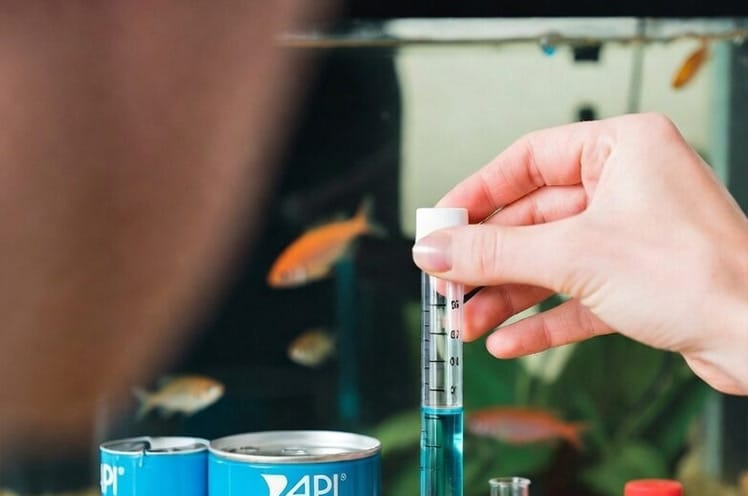
Don’t guess—test! This is the first step in how to bring down your fish tank’s pH. For beginners, I recommend using the API Freshwater Master Test Kit (around $30–$35) for reliable liquid results over using test strips alone. Check out my post on the most accurate test kits, so you’ll know what you need.
Steps:
- Collect fresh tank water.
- Add drops, shake, wait.
- Compare to the color chart in good light (natural light is best if possible).
- Test weekly and test daily while you’re making adjustments.
Target: 6.8–7.8 for freshwater aquariums. If the pH is high, don’t rush. Dropping pH too fast (more than 0.2–0.3 units per day) can cause shock to your flippered friends.
When I first started keeping fish, I only used test strips to check water parameters, and when I had a pH spike, I freaked out. I ended up losing several fish because I dropped the pH to around 4.0 way too fast.
Step 2. The 4 Easy Methods to Lower Aquarium pH
How to Lower pH in an Aquarium Quickly (Emergency Fixes)
Adding Chemical pH adjusters is the fastest and easiest way to lower pH in your aquarium. With that said, they are NOT a permanent fix. I would only suggest using liquid pH adjusters in an emergency. My advice would be to use some natural fixes for a long-term solution.
API pH Down
About: This is a freshwater aquarium water pH reducer that lowers aquarium pH in freshwater aquariums. It is safe for fish and plants.
How I Use It: I keep this bottle strictly for emergency adjustments. Because it can cause the pH to ‘yo-yo’ if your water is hard, I never dose it directly into my main display tanks. If I have to use it, I dilute the dose in a cup of tank water first and pour it in slowly near the filter output to ensure it’s distributed evenly.
Cost: Starts at about $5.
4.5/5 Stars (2,946 Reviews)
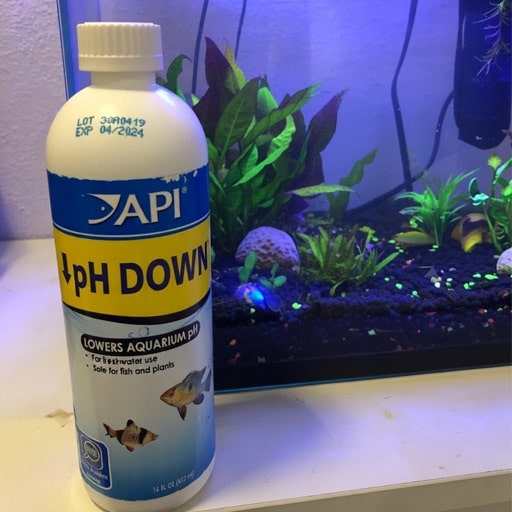
Using something like API pH Down (starting around $5) is easy. Add drops per gallon, mix, retest after 30 min to an hour. Now I tend to dose conservatively. I overdid it once, really badly, and crashed pH to 5.8!
Seachem Acid Buffer
About: This stuff lowers pH and buffers between 6.0 and 8.0 when used with Alkaline Buffer.
How I Use It: This is my go-to when I’m prepping water for my nano-betta tank. Since this buffer converts KH into CO2, I always use it in combination with Seachem Alkaline Buffer. I pre-mix my ‘target’ water in a 5-gallon bucket the night before a water change to let the chemistry settle before it ever touches my fish.
Cost: Get it for about $12
4.7/5 Stars (870 Reviews)
How to Lower Aquarium pH Naturally (Without Chemicals)
These are my go-to for gentle, long-term pH reduction. They release organic acids/tannins slowly, just like natural rivers or streams. No harsh chemicals, just nature doing the work.
Driftwood:
Driftwood releases tannins that lower pH gradually (often 0.5–1.0 units over several weeks) while tinting water light tea-brown (which many fish love). Choose aquarium-safe types like Malaysian driftwood or Mopani.
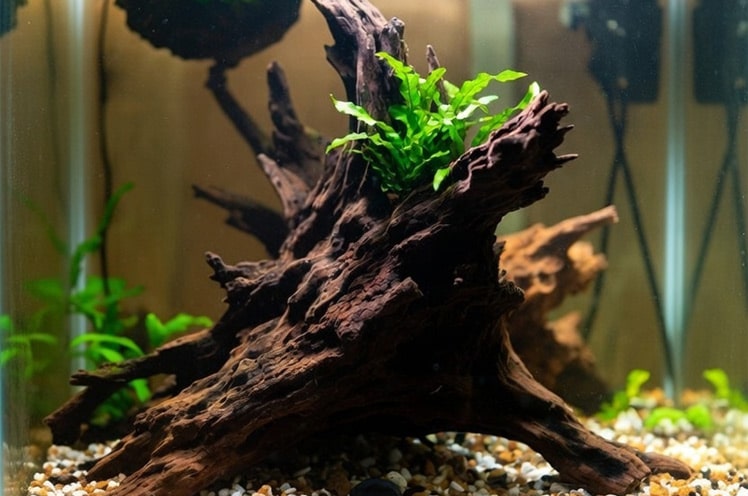
How I Use Driftwood:
In my 20-gallon long, two medium Mopani wood pieces keep the pH at a steady 6.8 despite my tap water being 7.9. I prefer Mopani because it’s dense and sinks immediately.
Before adding it, I boil the wood not just to kill bacteria, but to release some of its heaviest tannins early, under controlled conditions. Then I let it pre-soak in a bucket for a few days — this way, the most intense tannin release happens before the wood ever touches my tank, instead of dumping a sudden flood of dark water (and a sharp pH drop) all at once. The wood keeps releasing tannins at a much gentler pace afterward, which is exactly the slow, steady pH drop this method is built around.
Do yourself a favor and avoid random branches you find outside or on a beach. They can leach toxins into your tank’s water. I found out the hard way about 5 years ago by destroying the entire ecosystem of a 10-gallon fish tank.
- Pros: Aesthetic (natural look), permanent effect, great for bettas/shrimp.
- Cons: Yellow/brown tint in the water that does clear up over time; It’s a slow-action method for pH reduction.
- Cost: 2 to 4.5 Inch (Pack of 10), about $16
6 to 10 Inch (Pack of 3), about $20
9 to 14 Inch (Pack of 2), about $25
13 to 17 Inch (Pack of 1), about $30 - 4.2 Stars (8,501 Amazon Reviews)
Quick Tip: If you want the benefits of driftwood without the clutter, I often tuck a small mesh bag of aquarium-safe peat moss into my filter. It’s a logical, ‘hidden’ way to soften water and lower pH gradually.
Indian Almond Leaves (Catappa):
Dried leaves from the Terminalia catappa tree—add 1–2 medium leaves per 10 gallons. They release tannins faster than driftwood and have natural antifungal/antibacterial compounds (great for stressed fish).
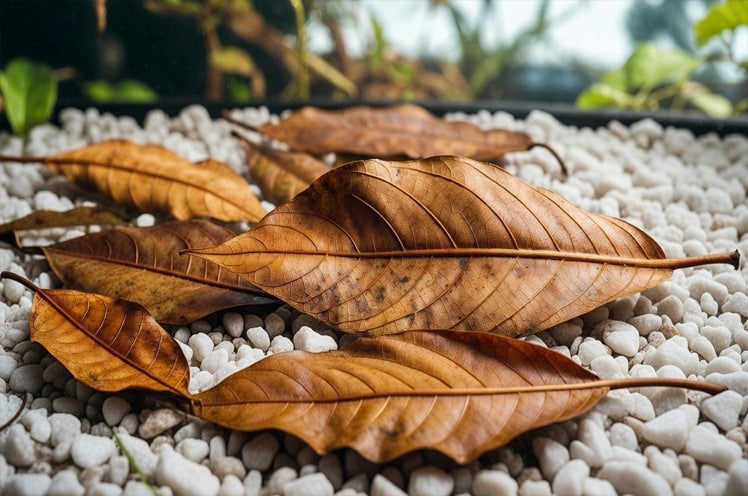
How To Use Indian Almond Leaves:
I love these for my shrimp and fry tanks. Instead of just tossing the whole leaf in, I often crumble a small piece and put it inside a mesh media bag in my filter. This gives me a more consistent release of tannins and prevents the leaves from rotting in the corners where I can’t reach them during cleaning.
- Rinse well and then add them directly to your tank. They’ll sink after a day or two. You’ll need to replace them every 4–6 weeks as they break down.
- Pros: Easy, cheap (~$10 for 50-pack), plus fish health bonuses.
- Cons: Can lead to a tea colored tint of the water; can lower pH too much if they’re overused. Make sure to keep an eye on KH levels.
- Cost: About $6
- 4.5 Stars (2,878 Amazon Reviews)
Method: Peat Moss (The “Hidden” Filter Fix)
If driftwood and almond leaves are the visible route, peat moss is the one nobody notices. It works on the same basic principle — releasing organic acids that gradually pull pH down — but it does it quietly, tucked inside your filter instead of sitting in the tank itself.
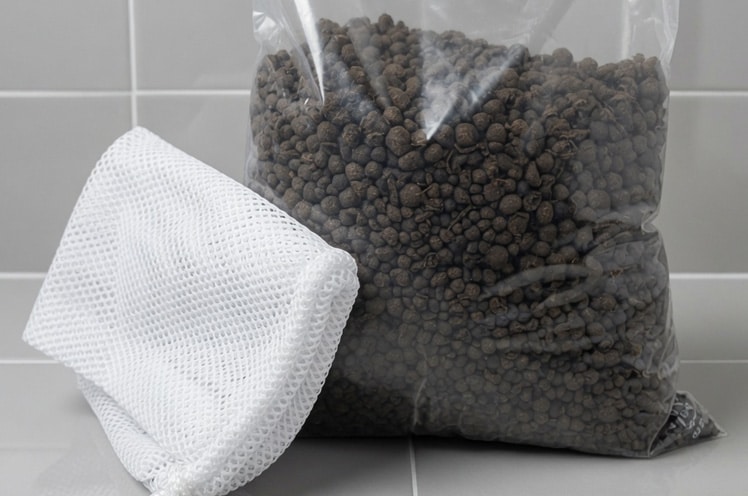
- How I Use It: I don’t bother with raw peat from a garden center; it’s messy and inconsistent. Fluval’s Aquatic Peat comes as granules, so I just drop a small mesh bag of it directly into my filter basket alongside my regular media. No rearranging the tank, no new “look” to account for — it just sits there working in the background.
- Pros: Invisible (no tank decor changes), works alongside any other method on this list, easy to remove if you want to stop.
- Cons: Slower and less predictable than driftwood for a strong pH drop; needs occasional replacement to keep working.
- Cost: About $23
4.4 Stars (2,298 Amazon Reviews)
Reverse Osmosis or Distilled Water Mix
This works great for hard tap water like mine. RO or distilled water has almost no minerals, so mixing it with tap water lowers pH and hardness gradually without shocking fish. This is also a quick way to lower pH, but don’t go crazy by doing a larger than 50% water change. This will drop pH way too fast.
Steps I Use:
- Get RO or Distilled water
- Test your tap water levels of pH/GH/KH first.
- Mix 50/50 (or 60/40 RO-heavy for a bigger drop).
- Remineralize with Seachem Equilibrium. RO or distilled water has zero minerals left in it, and 0 GH water isn’t “extra safe”; it’s actually unstable. Without minerals, your pH has nothing holding it steady and can swing unpredictably. Equilibrium adds back the calcium, magnesium, and trace elements your fish and plants actually need.
- Treat with dechlorinator and match the current tank water temp, and then do a 25–50% water change with new RO/Distilled water mix.
- Retest after 24 hours.
- Pros: Controllable, no tint, perfect for plants/shrimp.
- Cons: Tank water needs to be remineralized to avoid crashes.
- In my 55-gallon, 60/40 mix + Equilibrium additive. This dropped the water pH from 8.1 to 7.4 and has pretty much held stably.
Live Plants
Adding live plants like Java Fern and Anubias to your ecosystem is a fantastic natural way to manage your parameters. While active plants consume CO2 during the day (which slightly raises pH), they fundamentally prevent high pH spikes by consuming nitrates and organic waste before they can alter your mineral baseline. A heavily planted tank creates a natural biological buffer that smooths out sharp chemistry swings, making your environment incredibly stable for soft-water fish.
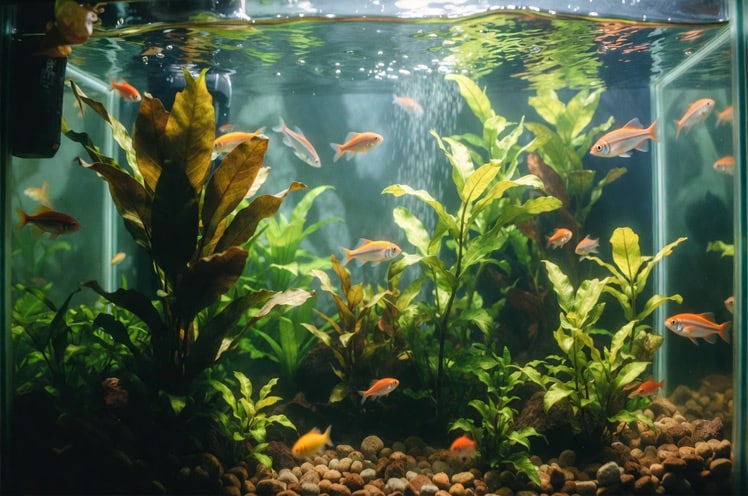
- Pros: Natural, enhances plants (my Java Fern/Anubias pearled beautifully).
- Cons: Doesn’t work alone for a high-KH tank — plants help stabilize chemistry, but if your water has heavy buffering capacity, you’ll still need one of the other methods above to actually move the pH.
Step 3. Monitor & Maintain Fish Tank Stability
- Test weekly (pH, KH/GH).
- Do 25% water changes with conditioner.
- Avoid using pH-raising substrates like limestone or coral gravel. Stick to a neutral option like CaribSea Super Naturals Gravel instead — see my post on the best substrates for your tank for more picks.
- Use air stones or bubblers for balance.
Pro Tip: Prioritize natural for long-term stability. You can use chemicals for quick fixes.
Common Mistakes to Avoid
- Rapid changes (more than 0.2–0.3 units/day). Go slow.
- Overusing chemicals. If you’re using something like pH Down, follow the instructions.
- Ignoring KH rebounds. Keep testing!
- Using Vinegar or other household products is unsafe for your fish!
How to Lower Aquarium pH Safely FAQs:
Why is my aquarium pH too high?
High pH (e.g., >8.0 in freshwater) often comes from tap water (7.9–8.5), limestone substrates, or low CO2.
How often should I test my aquarium pH?
Test weekly with a liquid or digital test kit, or daily if you’re actively adjusting pH or notice signs of stress like gasping or hiding.
Can I use vinegar to lower aquarium pH?
No, vinegar is unsafe! It’s too strong and lacks buffering.
Will lowering pH harm my fish?
Gradual changes (0.2–0.3 units/day) are safe. Rapid drops in pH stress fish.
Can live plants help lower pH?
Yes, indirectly. Plants like Java Fern consume CO2 during the day, which can slightly raise pH rather than lower it — but their bigger contribution is stability: by absorbing nitrates and organic waste, they prevent the swings that cause pH problems in the first place.
How does substrate affect pH?
Limestone or coral gravel raises pH. Use neutral substrates like CaribSea Super Naturals Gravel.
What if my tap water has a high pH?
Mix 50% RO/distilled water with tap water to lower the pH. Add Seachem Equilibrium to restore minerals.
How do I know if my pH is stable?
Test pH twice weekly after adjusting, aiming for 6.8–7.8 (freshwater) with a liquid or digital test kit. Stable pH shows no swings over 0.3 units/day.
Can I use these natural methods to lower pH in a saltwater aquarium?
No. Saltwater and marine reef tanks require a high, stable pH between 8.1 and 8.4. If your marine pH is climbing too high, it is usually caused by low indoor CO2 or a dosing error, not a lack of tannins. Never add driftwood, peat moss, or almond leaves to a marine setup, as the organic acids will destroy your saltwater buffering system.
Conclusion: How to Lower Aquarium pH Safely
Lowering your pH isn’t a one-time task; it’s a part of the ongoing logic of your tank’s ecosystem. Whether you choose the natural route with tannin-rich driftwood or the precision of RO water mixing, stability should always be your goal. Have a question about your specific water parameters? Drop a comment below or reach out on the contact page. Let’s get your water chemistry dialed in the right way.

I founded AquaLogicHQ to share hands-on, tested strategies that come from 3-month algae battles and countless hours perfecting the nitrogen cycle. My mission is simple: I've made most of the mistakes on my four active tanks and am sharing the answers so you can avoid disaster in yours. When I’m not elbows-deep in a water change, I’m putting the latest hobby gear through its paces to see if it actually delivers.
- Best Canister Filters For Fish Tanks: What I’d Actually Buy for a Big Tank - July 26, 2026
- The Best Nano Aquarium Tanks I’ve Actually Run in My Fish Room - July 19, 2026
- The Best Fish Tank Heaters: Ranked and Sized for Your Setup - July 4, 2026