Updated 16 June 2026
When it comes to anything, I believe in using the right tool for the right job. While I’ll always tell you that a Liquid Master Test Kit is the gold standard for accuracy, I also know that life happens. Sometimes you just need a 30-second ‘sanity check’ to make sure your ammonia hasn’t spiked. After 15 years of testing water in my 50-gallon community and nano tanks, I’ve learned which strips actually work and—more importantly—when you should never trust them.
Ammonia Test Strip TLDR Fast Facts:
- The Accuracy Verdict: Yes, ammonia test strips are accurate enough to detect dangerous toxic spikes (0.5 ppm and up), but they lack the sensitivity to read trace amounts (0.25 ppm) that a liquid kit will catch.
- The Major Flaw: Standard 6-in-1 multi-test strips do not include an ammonia pad. Because the chemicals are unstable when dried next to other reagents, you have to buy dedicated standalone ammonia strips.
- The Vertical Flick Trick: Never hold a test strip horizontally after dipping. The chemicals from neighboring pads will bleed across the paper, giving you a massive false positive. Always hold it vertically or give it a quick flick.
- The Storage Secret: Humidity destroys test strips. Keep your bottles inside a sealed Ziploc bag with a silica gel desiccant packet to prevent the air from ruining the paper reagents.
Disclosure: aqualogichq.com/ is a participant in the Amazon Services LLC Associates Program, as well as other affiliate programs, designed to provide a means for us to earn fees by linking to Amazon.com and affiliated sites at no extra cost to you. Please see the Affiliate Disclosure for more details.
Are Fish Tank Ammonia Test Strips Accurate? (The Short Answer)
Yes, ammonia test strips are accurate enough for general monitoring, but they are significantly less sensitive than liquid test kits. In my testing, strips effectively detect “dangerous” levels (over 0.5 ppm), but often fail to register trace amounts (0.25 ppm) that can still stress sensitive fish or indicate a stalling cycle. For daily peace of mind, they work; for troubleshooting a sick fish, use a liquid kit.
Why Most Multi-Test Aquarium Strips Miss the “Ammonia Gap”
If you just bought an “All-in-One” 6-in-1 test kit, you likely noticed a dangerous problem: the ammonia pad is missing. It’s a frustrating gap in the hobby. Manufacturers usually leave ammonia off the multi-pads because the chemicals required to test for it are unstable when dried onto paper alongside five other reagents. If you are specifically searching for aquarium test strips for ammonia to complete your setup, you have two main options. Keep reading to see how to handle each one.
Option A: Dedicated Aquarium Ammonia Strips
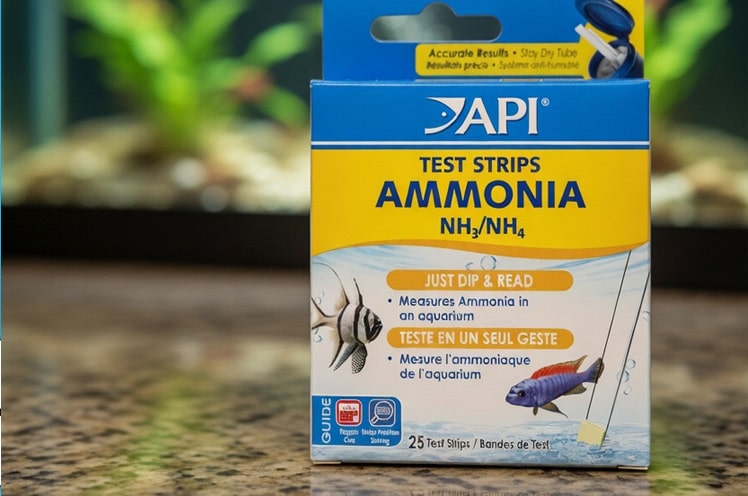
If you’re already using a 6-in-1 dip-test, the fastest way to bridge the gap is with a dedicated bottle of API Ammonia Test Strips. Since most “all-in-one” strips skip ammonia to keep the other pads stable, these standalone strips are designed to do one thing: measure NH3/NH4+.
- The Pro: No vials, no mixing, and no 5-minute wait. It takes 60 seconds to get a reading.
- The Reality Check: These are the most sensitive strips in your cabinet. If you leave the lid cracked or have high humidity in your fish room, the pads can “pre-react” with the air.
- My Advice: I use these for “Peace of Mind” checks on my established 50-gallon tank. If the fish look happy and I just want to confirm the cycle is holding, they are great. However, if you are currently cycling a new tank, the margin for error is too high—I always and only use a liquid kit for the first 6 weeks.
- Cost: About $16
- 4.3 Stars (Based on 1,952 Reviews)
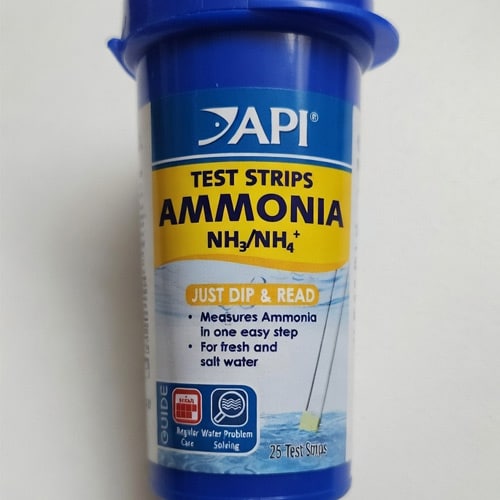
IMPORTANT TIP: The biggest mistake people make with ammonia strips is holding them horizontally. The chemicals from the pH pad can bleed into the Ammonia pad, giving you a false positive. I always hold my strips vertically or ‘flick’ them once to prevent cross-contamination. It’s a small logical step that saves a lot of panic.
Ammonia levels in your tanks can wreck everything in your aquarium. Testing is IMPORTANT, but finding the root cause is how you can fix the problem for good. I put together a simple guide on how you can lower ammonia levels safely and quickly. Check it out, it might save the lives of your aquatic friends.
Option B: The Hybrid Aquarium Ammonia Test Strategy
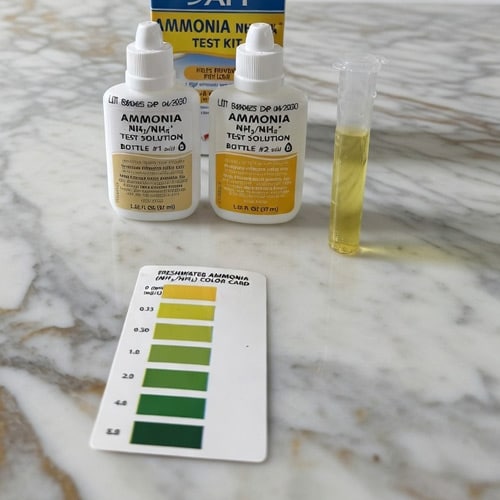
This is my personal favorite setup for a reliable fish room. You keep your Tetra 6-in-1 Strips for the “easy” stuff like pH and Nitrates, but you invest in a standalone API Liquid Ammonia Kit for the heavy lifting.
- The Value Play: A standalone liquid ammonia kit costs about the same as a pack of strips but is significantly more accurate.
- Why it works: You get the speed of strips for 90% of your testing, but the professional-grade precision for the one parameter that actually kills fish. In my 15 years in the hobby, this “Hybrid” method has saved me more money (and more fish) than any other testing trick.
- Cost: About $15
- 4.7 Stars (Based on 3,638 Reviews)
Your Best Ammonia Testing Options to Bridge the Gap
Not sure which option fits your setup? Here’s how they stack up side by side:
| Compairson | Option A: Dedicated Ammonia Strips | Option B: Hybrid Strategy |
|---|---|---|
| Speed | 60 seconds | 5 min for ammonia, 60 sec for everything else |
| Accuracy | Good for dangerous spikes (0.5 ppm+) | Liquid kit catches trace levels (0.25 ppm) |
| Cost | ~$16 per bottle | ~$15 liquid kit + existing 6-in-1 strips |
| Best For | Established tanks, quick peace-of-mind checks | New tanks, sick fish, cycling |
| Biggest Risk | Humidity degrades pads fast | Slightly more setup time for ammonia tests |
| My Verdict | Fine for daily monitoring | The smarter long-term setup |
If you are cycling a new tank or troubleshooting a sick fish, Option B wins every time. For everything else, Option A gets the job done fast.
Here’s What I Do With Aquarium Ammonia Test Strips
The moment this hybrid method proved itself was on a Tuesday morning about three years ago. I’d done a larger-than-usual water change on my 50-gallon community the night before — probably 40% instead of my usual 25% — and by morning, two of my tetras were hanging near the surface, moving slowly.
I grabbed my 6-in-1 strip first out of habit. pH looked fine, nitrates were normal, nothing obviously wrong. But something felt off. So I pulled out my API Liquid Ammonia Kit — the one I keep specifically for moments like this — and ran a proper test. It came back at 0.5 ppm. Not catastrophic, but enough to stress sensitive fish, and exactly the kind of trace reading that a strip would have missed entirely.
Turns out the large water change had temporarily disrupted the bacterial colony on my filter sponge. A targeted dose of Seachem Prime to detoxify the ammonia, followed by a small dose of starter bacteria, and by that evening, everyone was swimming normally again.
That’s the moment I stopped thinking of the liquid ammonia kit as “extra” and started treating it as non-negotiable. The strips told me everything was fine. The liquid kit told me the truth.
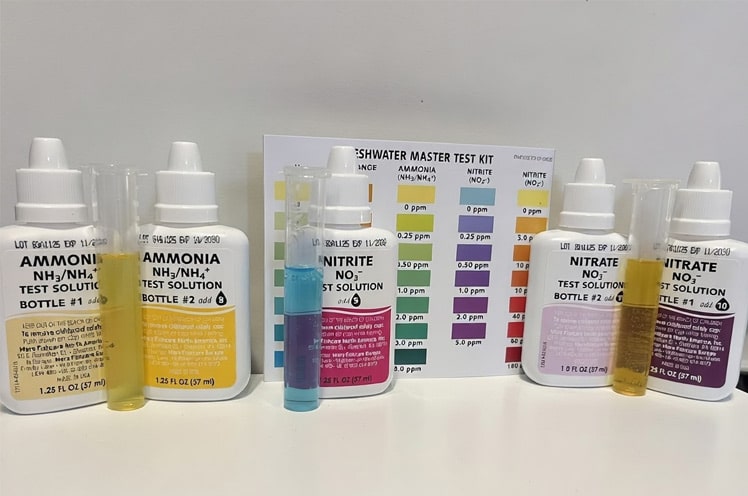
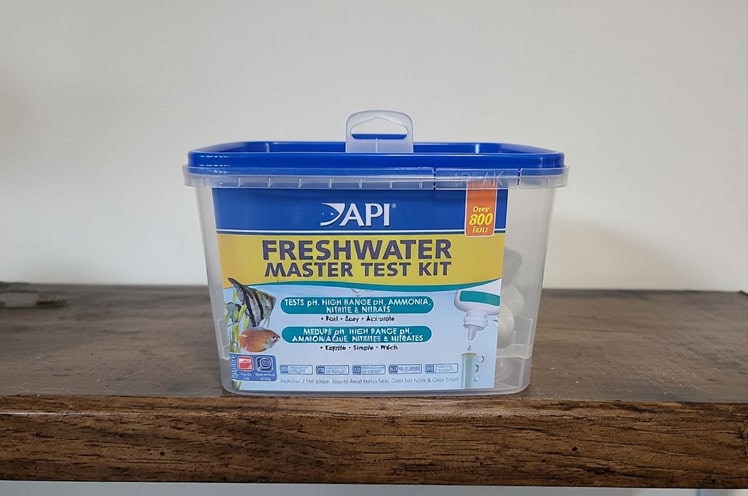
I have a post all about the most accurate test kits for aquariums, or you can check out the API Master Test Kit at Amazon. At about $35, it’s a deal!
- Quick Note: Ammonia is the #1 killer in a new tank. A liquid kit is significantly more accurate and costs about the same as a pack of single-purpose ammonia strips.
How to Test for Ammonia in an Aquarium with Strips
Testing your water with ammonia strips takes under two minutes if you follow this sequence. The order matters — skipping steps or doing them out of sequence is the main reason people get false readings.
Step 1: Dry Your Hands Completely
Before you even open the bottle, make sure your hands and fingers are bone dry. Any moisture on your fingers when you reach into the bottle will begin degrading the remaining strips immediately. I keep a dedicated hand towel next to my test kit for exactly this reason.
Step 2: Remove One Strip and Close the Lid Immediately
Take out a single strip and close the bottle lid right away — don’t leave it open while you test. Ammonia strips are more sensitive to atmospheric humidity than any other test type. Even a few minutes of open-air exposure in a humid fish room can begin pre-reacting the pads before they ever touch the water.
Step 3: Dip the Strip
Submerge the ammonia pad into your tank water for exactly 5 seconds. Don’t swirl it aggressively or wave it around — a clean, still dip gives you the most accurate result.
Step 4: Hold it Vertical and Wait
Remove the strip and immediately hold it completely vertical for 60 seconds. This is the most important step most people skip. Holding it horizontally allows water and chemicals from neighboring pads to bleed across into the ammonia section, giving you a false positive that will send you into a panic for no reason.
Step 5: Read the Result in Natural Daylight
Match the pad color to the chart on the bottle under natural daylight or a white light source. Never read it under your aquarium’s blue or purple LEDs — those wavelengths distort your color perception enough to make a safe yellow reading look like a concerning green. Hold the strip about an inch away from the color chart rather than pressing it flat against it, and if the color falls between two squares, call it the higher of the two as a precaution.
Troubleshooting Your Fish Tank Ammonia Test Strip Results
Most false readings trace back to one of three culprits: humidity, bad lighting, or old reagents. Here’s how to catch each one before it costs you a fish.
The #1 Reason Your Test Strips Are Giving False Readings
Most hobbyists don’t realize that ammonia test strips are incredibly sensitive to atmospheric humidity. Leave the lid off the bottle for even five minutes during a water change, and the pads start reacting with the moisture in the air before they ever touch your tank.
If your pads look faded or off-color before you’ve even dipped them, that bottle is already compromised. Throw it out — a false “safe” reading is more dangerous than no reading at all, because it tells you everything is fine when it might not be.
How to Read “In-Between” Colors
The most frustrating moment with any colorimetric test is when the result sits between two squares on the chart. When that happens, hold the strip about an inch away from the card rather than pressing it flat, and always read it in natural daylight. Your aquarium’s blue or purple LEDs distort color enough to turn a borderline reading into a guessing game. If you’re still stuck between two shades, round up — treat it as the more serious reading and retest in a few hours.
The Expiration Date Warning
Reagents degrade, even in liquid kits. On API bottles, the last four digits of the lot number tell you the manufacture date — for example, 0524 means May 2024. My rule: if a bottle is over two years old, it goes in the trash, no exceptions. A false “0 ppm” reading from an expired kit can talk you out of a water change your fish desperately need, which is exactly the moment you can least afford to be wrong.
A Short Comparison Table
| Feature | Ammonia Test Strips | Liquid Ammonia Kit |
|---|---|---|
| Speed | 60 Seconds | 5 Minutes |
| Accuracy | Good for “Vibe Checks” | Gold Standard for Cycling |
| Price Point | 14-$16 | $12-$18 |
| Best For | Completing a 6-in-1 kit | New Tanks & Sick Fish |
Aquarium Test Strips for Ammonia Levels FAQs
Do aquarium test strips expire?
Yes. Most test strips have a shelf life of about 12 to 24 months. However, they are incredibly sensitive to humidity. If you leave the lid off or reach in with wet fingers, the reagents can degrade in weeks. If the pads look discolored before you even dip them, throw the bottle away—an inaccurate test is worse than no test at all.
Why does my liquid ammonia test look slightly green (0.25 ppm) even after a water change?
This is a common false positive. If you use a water conditioner like Seachem Prime, it detoxifies ammonia by turning it into ammonium. Most liquid kits (like API) test for Total Ammonia, which includes both the toxic and non-toxic versions. If your fish look healthy and your Nitrites are 0, wait 24 hours for the chemicals to stabilize before testing again.
Can I use 6-in-1 strips to cycle a new tank?
I don’t recommend it. Most 6-in-1 strips do not test for ammonia, which is the first and most dangerous spike in a new tank. Additionally, during a cycle, you need to know exactly when your levels hit 0 ppm. Strips are great for broad ranges, but they lack the precision needed to confirm your bio-filter is fully established.
How do I read the liquid test colors accurately?
Colorimetric tests are notorious for being hard to read under artificial light. Always hold your vial against a solid white background and view it in natural daylight. Blue or yellow-tinted indoor bulbs can make a yellow Safe reading look like a green Danger reading.
Are expensive digital testers better than liquid kits?
Digital checkers (like those from Hanna) are the most accurate, but they are usually overkill for freshwater tanks. They require regular calibration and expensive reagents. For 99% of hobbyists, a high-quality liquid kit like the API Master Test Kit provides more than enough accuracy for a fraction of the price.
Why is my ammonia test strip yellow, but my fish are gasping?
This is the Silent Killer scenario. If your test strip is old or has been exposed to humidity, the reagent pad can lose its sensitivity. It stays yellow (Safe) even when ammonia levels are dangerously high. If your fish are gasping at the surface or have red, inflamed gills, do not trust the strip. Perform a 50% water change immediately and re-test with a liquid kit.
Can I use the same test strip for freshwater and saltwater?
It depends on the brand, but generally, no. Ammonia chemistry behaves differently in high-pH saltwater versus freshwater. Most standard multi-strips are formulated for freshwater only. If you have a marine tank, always check the bottle for a Marine Safe label, or stick to a dedicated liquid kit like the API Saltwater Master Test Kit.
Does water temperature affect my ammonia test reading?
Temperature (and pH) affects how toxic the ammonia is to your fish — aquaculture research confirms the toxic, un-ionized fraction of ammonia rises sharply as both pH and temperature increase — but the test strip is designed to measure Total Ammonia. Whether your water is 68°F or 80°F, the color on the strip should remain the same, but the fish in the warmer, higher-pH water will be in much more danger at the same reading.
Why are ammonia strips sold separately from 6-in-1 kits?
It’s all about chemical stability. The reagents used to detect ammonia are aggressive and can bleed into neighboring pads (like Nitrate or pH) if they are placed on the same strip. To give you an accurate reading for the other 6 parameters, manufacturers separate the ammonia test into its own dedicated bottle.
How often should I test for ammonia in an established tank?
In a tank that has been stable for over six months, a vibe check with an ammonia test strip once a week is usually enough. However, you should test immediately if you add new fish, move your filter media, or notice a sudden cloudy water bloom, as these are all signs that your nitrogen cycle might be struggling.
Final Verdict: Don’t Let the Aquarium “Ammonia Gap” Catch You Off Guard
Testing your water shouldn’t feel like a high-school chemistry final every single day. The logic behind using ammonia test strips is simple: they are your early warning system. They aren’t meant to be the definitive answer, but they are the fastest way to catch a disaster before it starts.
In my own fish room, I use strips for “Tuesday morning checks,” but I never rely on them when a fish is acting lethargic or a new tank is cycling. Being a successful hobbyist means knowing when to value speed and when to value precision. If you’re looking for a quick “yes or no” on your water quality, strips have a place on your shelf. But the moment that color pad starts to change, you need to be ready to pivot to the liquid kits for the real story. Don’t let the convenience of a strip lure you into a false sense of security—stay logical, keep a liquid kit on standby, and always verify before you treat.
Have questions about a weird reading you’re seeing on your strips? Drop a comment below or send me a message using the contact page.

I founded AquaLogicHQ to share hands-on, tested strategies that come from 3-month algae battles and countless hours perfecting the nitrogen cycle. My mission is simple: I've made most of the mistakes on my four active tanks and am sharing the answers so you can avoid disaster in yours. When I’m not elbows-deep in a water change, I’m putting the latest hobby gear through its paces to see if it actually delivers.
- Best Canister Filters For Fish Tanks: What I’d Actually Buy for a Big Tank - July 26, 2026
- The Best Nano Aquarium Tanks I’ve Actually Run in My Fish Room - July 19, 2026
- The Best Fish Tank Heaters: Ranked and Sized for Your Setup - July 4, 2026