Updated 7 July 2026
Your fish tank heater is a life-support system, not an accessory. Fish are ectothermic — their body temperature, immune function, and digestion are entirely driven by the water around them. A sudden four-degree drop can trigger sickness like ICH — peer-reviewed research confirms temperature stress is a key predisposing factor for ich outbreaks by compromising fish immune response. A thermostat that fails can cook a tank overnight. I’ve spent fifteen years maintaining tropical freshwater tanks, and I’ve seen both failures firsthand. This guide cuts past the spec sheets to tell you what actually holds up, what to size correctly for your specific setup, and the one placement mistake that almost every beginner makes.
The TLDR: Best Fish Tank Heaters
- The Golden Safety Rule: Any tank 40 gallons or larger should run two smaller heaters instead of one — split the wattage, place them at opposite ends. If one fails, the other keeps your fish alive until you can replace it.
- Skip the “5 Watts Per Gallon” Box Math: That rule only works at a roughly 15-18°F room-to-target differential — for most homes, it’s oversized enough to be dangerous if the thermostat ever sticks on. Use the calculator below to size off your actual room temperature, not a worst-case guess.
- Best Glass Workhorse — Eheim Jager TruTemp: ±0.9°F accuracy and a mechanical recalibration ring no other brand offers. Regularly lasts a decade. Just measure your tank’s interior height first — it’s a big unit.
- Best Indestructible Pick — Finnex STE Titanium: A solid titanium element with an external controller. The only heater on this list I’d trust in a tank with oscars, large cichlids, or rays.
- Best Shatterproof Value — Aqueon Pro Adjustable: A resin-filled shell that physically cannot crack, plus a red/green indicator light that tells you what it’s doing from across the room.
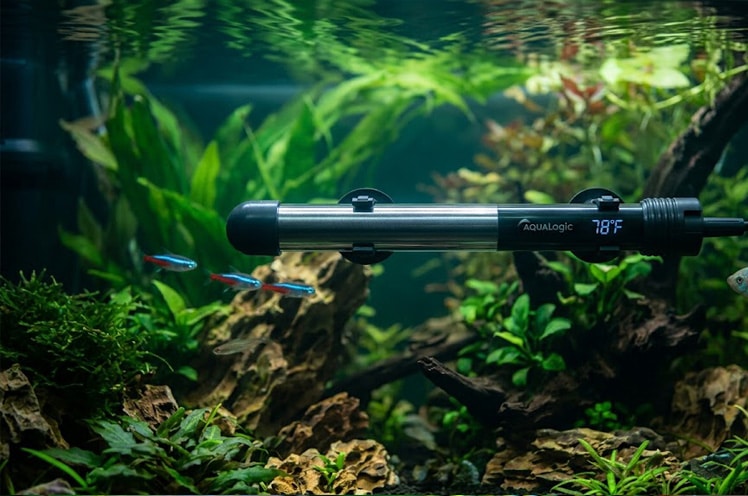
- Best for Aquascapes — Fluval M-Series: Mirrored glass that reflects your substrate and plants — the closest thing to an invisible heater in a planted display.
- Best Budget Nano Pick — Hygger Digital Mini: External digital display and a built-in fish guard at an entry-level price. Best kept to tanks under 20 gallons — budget to replace it every couple of years rather than expecting decade-long service.
| Product Recommendations | Best For | Casing | Price | |
|---|---|---|---|---|
| Eheim Jager TruTemp | Long-term reliability | Schott glass | $30-$50 | Check price |
| Finnex STE Titanium | Large / aggressive tanks | Titanium | $90-$110 | Check price |
| Fluval M-Series | Planted tanks | Mirrored glass | $32-$36 | Check price |
| Aqueon Pro Adjustable | Beginner / community tanks | Thermal polymer | ~$55 | Check price |
| Hygger Digital Mini | Nano / small tanks | Quartz glass | $17-$26 | Check price |
Jump Down To Reviews
Disclosure: AquaLogicHQ.com is a participant in the Amazon Services LLC Associates Program, as well as other affiliate programs, designed to provide a means for us to earn fees by linking to Amazon.com and affiliated sites at no extra cost to you. Please see the Affiliate Disclosure for more details.
Do You Actually Need an Aquarium Heater?
Unless you’re keeping true coldwater species, the answer is almost always yes.
Fish are ectothermic. Unlike humans, they generate no body heat of their own. Their metabolism, immune response, and ability to fight off infection are entirely driven by the temperature of the water around them. Your home might feel comfortable to you, but a four or five degree overnight drop — from an open window, a cold night, or an air conditioning unit cycling on — can be enough to crash a tropical fish’s immune system and trigger an ich outbreak within days.
The Exceptions: When You Can Skip the Heater
You can go without a heater only if you’re keeping true coldwater species in a room that stays consistently within their preferred range:
- No heater needed: White Cloud Mountain Minnows, Fancy Goldfish, and North American natives like Darters — provided your room never drops below 60°F.
- Heater non-negotiable: Bettas, Discus, Angelfish, Tetras, and virtually all livebearers (Guppies, Mollies, Platys) need a steady 75°F to 84°F to digest food and fight off infection.
The Summer A/C Trap
A mistake I see constantly — unplug the heater in summer because the house feels warm enough. Don’t do it unless your tank has gotten too hot. See my post on cooling your aquarium for more info.
Modern climate control creates invisible temperature swings. When your air conditioning kicks on overnight or a vent blows directly toward the tank, water temperature can drop faster than you’d expect. A plugged-in heater won’t run when the room is warm — but it will fire up instantly to catch a sudden drop before your fish feel it.
A heater isn’t just about making water hot. It’s about keeping it perfectly stable.
How to Choose the Right Heater Size (The Sizing Matrix)
If you look at the packaging of most commercial aquarium heaters, they will give you a generic recommendation like “5 watts per gallon.” In an average household, this is actually highly oversized and potentially dangerous — if an oversized heater is left in the “ON” position, it has enough raw power to boil your tank before you even notice.
That 5W/gallon number isn’t wrong on its own — it’s wrong applied blindly, regardless of how cold your room actually gets. A tank in a heated house that never drops below 70°F needs a fraction of that. The calculator below uses that same baseline, but scales it to your real room-to-target differential instead of a worst-case guess.
To size a heater correctly, you have to look at your Temperature Lift—the difference between the coldest your room ever gets (like a winter night) and the target temperature your tropical fish need.
The calculator below accounts for your specific temperature differential and tank type to give you a precise wattage recommendation.
Aquarium Heater Wattage Sizing Matrix
For any tank 40 gallons or larger, I highly recommend splitting your total required wattage between two smaller heaters placed at opposite ends of the tank instead of using one massive heating element.
If you need 300W of total heat, run two 150W heaters. If one fails “OFF” in the winter, the remaining 150W heater will prevent the tank from dropping into critical freezing territory. If one sticks “ON” during the summer, a single 150W element isn’t powerful enough on its own to overheat a large tank, giving you a vital window of time to catch the problem.
The Aqualogic Heater Size Calculator
Have an odd-sized tank, a heavy acrylic build, or an exceptionally cold room? Use our custom calculator below to dial in your precise equipment needs instantly:
Aquarium Heater Size Calculator
Enter your tank size and temperature needs — get the exact wattage you need.
| Tank Size | Min. Watts | Buy This Size |
|---|---|---|
| 5 gal | 25W | 50W |
| 10 gal | 50W | 75–100W |
| 20 gal | 100W | 150W |
| 29 gal | 145W | 200W |
| 40 gal | 200W | 250–300W |
| 55 gal | 275W | 300W |
| 75 gal | 375W | Two × 200W |
| 100 gal | 500W | Two × 300W |
Chart assumes a 10°F differential. Use the calculator above for precise results.
One Number the Calculator Can't Know: Your Real Water Volume
The calculator above asks for your tank size in gallons — but that labeled number is your tank's empty volume, not what's actually in there once substrate, rocks, driftwood, and decorations displace some of that space. A heavily aquascaped tank can hold noticeably less real water than the number printed on the box.
For most community setups with a standard 2-inch substrate bed and modest decor, the difference is small enough to ignore — round up slightly and move on. But if you're running a deep substrate slope, a large piece of driftwood, or heavy rockwork, your actual water volume can run meaningfully lower than your tank's labeled size. I cover exactly how much substrate displaces in my substrate calculator guide, if you want to get more precise.
The practical fix: if your tank is heavily decorated, enter a slightly lower gallon count into the calculator above than your tank's official rating — even rounding down by 10% is a reasonable adjustment for a well-aquascaped setup. Undersizing your heater estimate slightly is far safer than oversizing it, since the calculator already builds in a 20% buffer on top of whatever number you give it.
What About In-Line Heaters?
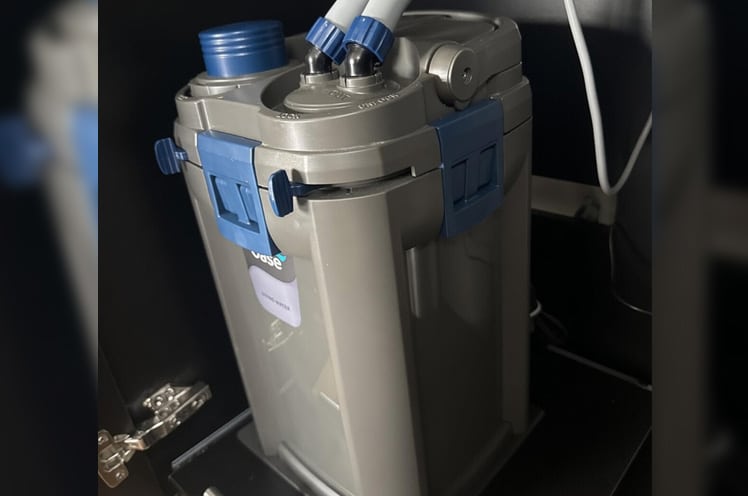
Everything reviewed in this guide is a submersible, in-tank heater — but if you're running a canister filter, you have another option worth knowing about: an in-line or integrated heater that lives outside the display tank entirely.
How they work:
Instead of a heating element sitting visibly in your water column, the heater is plumbed into your canister filter's output line (or built directly into the canister body, like the OASE BioMaster 2 Thermo I cover in my canister filter guide). Water gets heated as it passes through on its way back to the tank, so there's no glass, titanium, or plastic housing anywhere in your display — just clean water coming out of the return.
Why you'd choose it:
- Zero visible equipment. For aquascapers who already went with a mirrored heater like the Fluval M-Series to hide it, an in-line setup does one better — there's nothing to hide because nothing is in the tank at all.
- No thermal shock risk during water changes. Since the heater lives inside the sealed canister rather than the display, you don't need to worry about the glass-cracking scenario the 15-Minute Rule protects against — though you should still confirm your specific canister's heater is rated for a brief dry period during maintenance.
- One less thing bumping into decorations or fish. No element for an oscar to slam into, no risk of it getting buried in substrate.
The tradeoff: you're locked into running a canister filter, and if the canister needs maintenance or the heater component fails, you're dealing with the whole unit rather than swapping a $30 glass heater. It's also not something you can retrofit onto an existing HOB-filtered tank without adding a canister first.
Bottom line: if you're already running (or considering) a canister filter on a planted or heavily aquascaped tank, it's worth looking at an in-line or integrated option before defaulting to one of the five submersible heaters below. If you're on a HOB or don't want the added cost and complexity of canister filtration, the picks in this guide are still the right call.
Best Aquarium Heater Brand Comparison
Picking the right heater isn't just about choosing a wattage and clicking add to cart. Every major brand in this hobby has a distinct engineering philosophy, a specific type of tank they're built for, and a known failure mode worth understanding before you commit. Here's how the big players actually compare — plus a warning about the budget trap that ends more tanks than it should.
Eheim: The Glass Workhorse
- The Reputation: Old Faithful. Eheim is a legendary German brand with a track record that stretches back decades. When experienced fishkeepers say "just buy an Eheim," this is why.
- Design Philosophy: Laboratory-grade Schott glass, large heating surface for efficient heat transfer, and a mechanical recalibration ring that no other brand offers. If the dial reads a degree or two off your separate thermometer, you can physically adjust it back to true accuracy without buying a new heater.
- The Catch: They are monsters in size. A 200W or 300W Eheim is significantly longer and thicker than almost every competitor — make sure you check the exact measurements before buying, because they won't fit in shorter or shallow tanks.
Finnex: The Titanium Heavyweight
- The Reputation: The gold standard for large setups, aggressive fish, and high-value marine reef tanks where glass failure is not an option.
- Design Philosophy: Solid titanium heating elements that are essentially indestructible. Large cichlids, oscars, and rays can slam into the rod all day without a scratch. The digital controller sits completely outside the water, keeping sensitive electronics dry and the heating element itself completely free of failure points.
- The Catch: Higher upfront cost — you're buying both a premium titanium rod and an external controller. Worth it for the right tank, but harder to justify for a peaceful community setup.
Fluval: The Sleek Innovator
- The Reputation: Modern, aesthetically considered, and reliably mid-to-premium. Fluval builds gear that works well and looks good doing it.
- Design Philosophy: Two lines worth knowing. The M-Series uses a mirrored borosilicate glass finish that reflects your substrate and plants, effectively hiding the heater in a display tank. The E-Series goes further with a dual-sensor digital microprocessor that displays live water temperature and changes screen color — green for stable, blue for cool, red for alert — so you can check your heater's status at a glance from across the room.
- The Catch: The M-Series flow sensors can trigger false alerts if the heater isn't placed in a strong enough current. It needs to be positioned near the filter output to read accurately.
Hygger: The Budget Digital Contender
- The Reputation: The direct-to-consumer brand that keeps forcing established manufacturers to justify their price points. More features per dollar than anything else on this list.
- Design Philosophy: External digital temperature displays, out-of-water auto shut-off, and built-in protective guards packed into affordable quartz glass and titanium units. They've made safety features that used to be premium additions standard at entry-level prices.
- The Catch: The long-term component reliability simply doesn't match the decade-long track record of Eheim. A Hygger bought today likely won't be running in ten years the way a Jager TruTemp will. For a nano tank or a secondary setup, that trade-off is easy to accept. For a high-value display tank, it's worth thinking twice.
Aqueon: The Mainstream Value Leader
- The Reputation: The most widely available brand in the hobby. If you've ever bought a starter kit at a big-box pet store, it almost certainly came with Aqueon gear inside.
- Design Philosophy: Their Pro Series swaps traditional glass for a resin-filled thermal plastic shell with an aluminum core — genuinely shatterproof, which makes it the right call for turtle tanks, heavily decorated setups, or any tank where a displaced rock could crack a glass heater. The red/green LED indicator (red when heating, green when at temp) is one of the most practical visual features on any heater at this price point.
- The Catch: Thermostat reliability at the component level can be inconsistent over time. Not a dealbreaker at this price point, but worth keeping a backup thermometer on the tank and replacing the unit every two to three years rather than waiting for it to fail.
A Warning About No-Name Amazon Heaters
If you search Amazon or budget marketplaces, you'll find dozens of alphabet-soup brands selling 300W digital heaters for under fifteen dollars. Avoid them.
These units are mass-produced with almost zero quality control and substandard bimetallic thermostat strips. The primary failure mode for any aquarium heater is the internal relay sticking in the on position. When a cheap unbranded heater fails that way, it will keep pumping electricity into the water until it cracks, electrocutes the tank, or cooks your fish — and there's no safety shutoff to stop it. I've seen the aftermath. Saving ten dollars on a heater is never worth losing hundreds of dollars in livestock and years of work building a tank. Stick to reputable brands or the brands above.
Top 5 Fish Tank Heaters Reviewed
1. Eheim Jager TruTemp (Best Glass Workhorse)
If you want laboratory-grade precision and a heater built to last a decade, the Jager TruTemp is the old-school king of the hobby. I've run the 150W version in my 29-gallon community tank for three years without a single degree of thermostat drift.
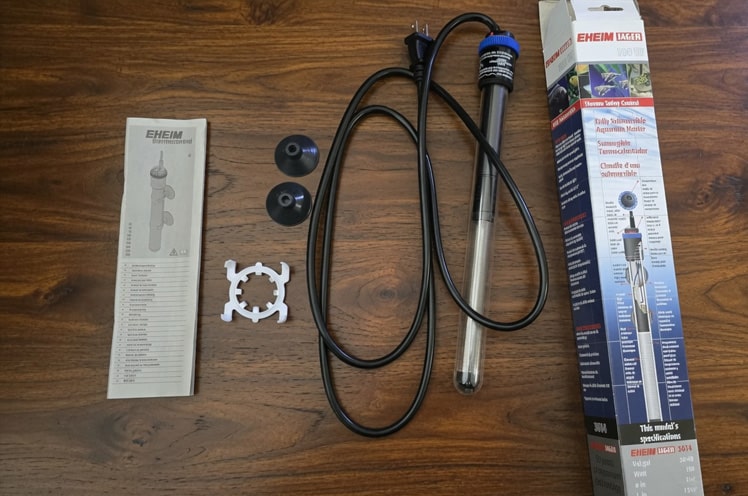
- What I Like: Unrivaled accuracy at +/- 0.9°F and a completely unique mechanical recalibration ring. If the dial ever reads off from your separate thermometer, you can physically adjust the ring to lock it back to true calibration — no other heater on this list offers that.
- What I Don't Like: They are absolute units in size. A 200W or 300W Eheim is significantly longer and thicker than every competitor, making them difficult to hide in shallow or shorter tanks.
- What You Should Know: The temperature dial is intentionally stiff to prevent accidental shifts during cleaning. It also features a dry-run safety cutoff that kills power if the water level drops below the element.
- Quick Tip: Measure the interior height of your tank before ordering — Eheim publishes exact dimensions on their product pages and it's worth checking before the box arrives.
- Cost: About $30 for 25w and goes to $50 for 300w
- 4.0 Stars (370 Amazon Reviews)
2. Finnex STE Titanium Series (Best Premium & Indestructible)
For large tanks, aggressive fish, or high-value reef setups, the Finnex STE is the only heater I'd trust without reservation. The titanium rod is genuinely indestructible — I've had my oscars body-slam the 300W I have running in my 50-gallon, and it hasn't left a mark.
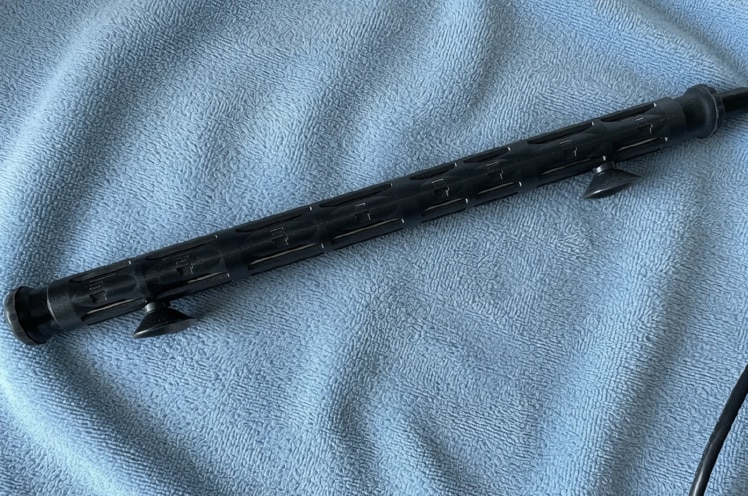
- What I Like: The titanium heating rod eliminates the single biggest risk of any standard glass heater — shattering. Large cichlids, oscars, and rays can hit it all day. Dual-circuit redundancy in the external controller adds a second layer of overheating protection.
- What I Don't Like: Higher upfront cost than everything else on this list. You're purchasing both a premium titanium element and a specialized external digital controller if you decide you need one.
- What You Should Know: All temperature adjustments happen on the external controller — there are no dials or adjustment points on the rod itself, which keeps all sensitive electronics completely out of the water.
- Quick Tip: If you run an advanced controller like a Neptune Apex, you can purchase just the standalone Finnex titanium element and plug it directly into your controller's heating port.
- Cost: Starts at $90 for 300W and goes up to $110 for 800W
- 4.5 Stars (78 Amazon Reviews)
3. Fluval M-Series (Best Low-Profile Aesthetic)
For aquascapers who want a reliable glass heater that doesn't ruin the visual design of the tank, nothing on this list comes close to the M-Series. I use one in my 20-gallon long planted display specifically because it disappears.
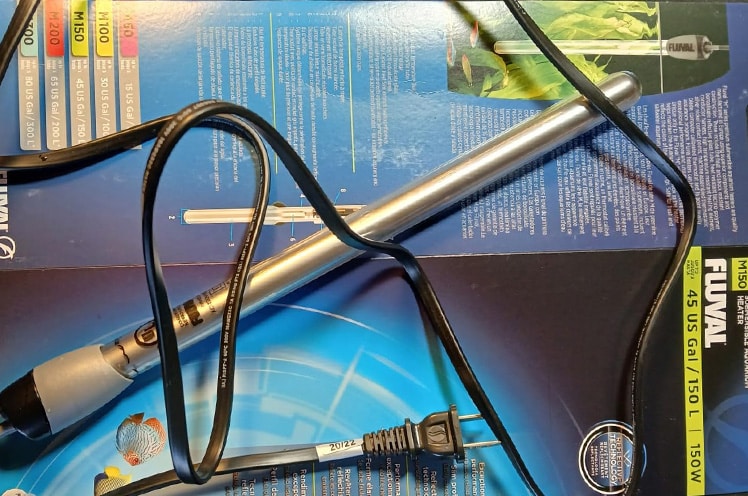
- What I Like: The mirrored borosilicate glass finish reflects your substrate, plants, and background — in a well-planted tank it's effectively invisible. It's the cleanest-looking heater available at any price point.
- What I Don't Like: Standard glass exterior with no built-in protective guard, making it a poor choice for large aggressive fish or heavily decorated tanks where rocks shift during maintenance.
- What You Should Know: No dry-run auto shutoff sensor. You must unplug it before lowering the water level during a water change — follow the 15-minute rule covered in the placement section below.
- Quick Tip: Mount it directly in the path of your filter output. The M-Series thermostat reads most accurately in high flow, and it ensures heat distributes evenly across the whole tank rather than just the area around the heater.
- Cost: Starts at $32 for a 50W and goes up to $36 for a 200W
- 4.4 Stars (5,597 Amazon Reviews)
4. Aqueon Pro Adjustable (Best Shatterproof All-Rounder)
An exceptional middle ground for community tanks, turtle setups, and anyone who's ever cracked a glass heater during a water change and doesn't want to do it again.
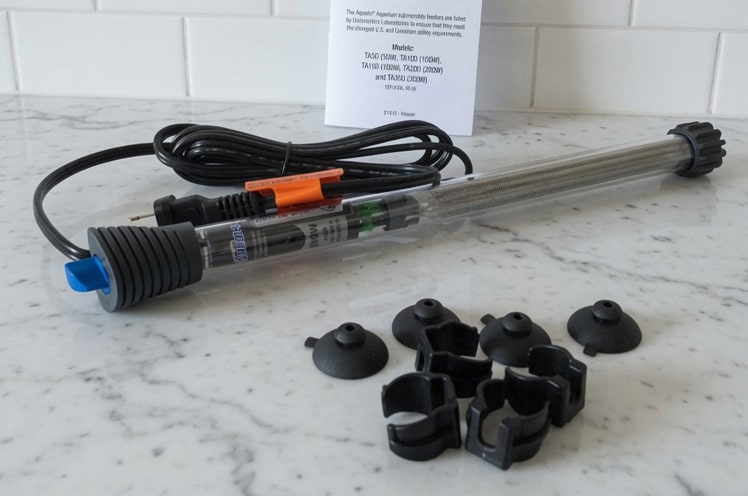
- What I Like: Resin-filled thermal plastic shell with an aluminum core — entirely shatterproof. The red/green LED indicator is one of the most practically useful features on any heater at this price point. Red means it's actively heating, green means it's hit its target. You can check it from across the room.
- What I Don't Like: The adjustment dial can be genuinely difficult to read clearly in low canopy lighting. A small flashlight during setup saves frustration.
- What You Should Know: Thermostat accuracy holds at +/- 1°F, which is solid for the price. It also features an internal safety switch that cuts power if the unit tilts too far off-vertical or runs dry — a forgiving feature for beginners.
- Quick Tip: Keep a dedicated backup thermometer on any Aqueon Pro tank and replace the unit every two to three years as preventative maintenance rather than waiting for a thermostat failure.
- Cost: Starts about $55 for 100W
- 4.3 Stars (308 Amazon Reviews)
5. Hygger Digital Mini (Best Value for Nano Tanks)
A modern direct-to-consumer heater that packs features that used to cost twice as much into an entry-level price point. For tanks under 20 gallons, it's genuinely hard to argue with.
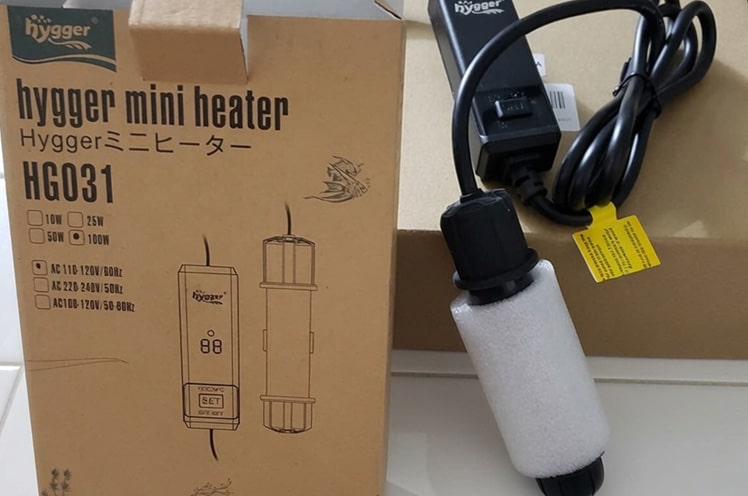
- What I Like: External digital temperature display, built-in plastic fish guard, single external button for temperature adjustment — you never have to get your hands wet to change the setting. Feature-to-price ratio is unmatched at this end of the market.
- What I Don't Like: Long-term electronic durability doesn't match heritage brands like Eheim. This is not a ten-year heater. Budget for replacement every two years and you won't be caught off guard.
- What You Should Know: No dedicated out-of-water shutoff sensor. Always cut power at the strip before performing a water change to prevent the element from running dry.
- Quick Tip: Pair it with a separate $10 digital thermometer and check them against each other when the heater is new. If they read more than 1°F apart out of the box, calibrate your expectations — or return it.
- Cost: Starting at $16.99 for 10W and up to $25.99 for 100W
- 4.6 Stars (574 Amazon Reviews)
Proper Installation & Placement Tips
You could buy the most expensive titanium heater on the market and still end up with cold spots, a crashed thermostat, or a cracked tube — if you put it in the wrong place or handle it the wrong way during maintenance. Placement and installation are where most heater problems actually start.
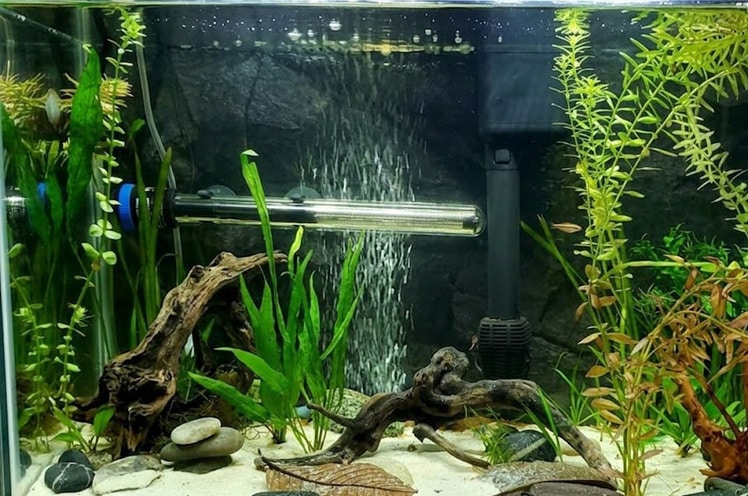
Position It in Water Flow
Aquarium heaters have no internal circulation. They rely entirely on the tank's current to pull cold water across the element and push warm water through the display. Get this wrong and you get short-cycling — the water immediately around the heater hits target temperature, the thermostat shuts off, and the rest of the tank stays cold.
- The right position: Directly next to your filter intake, filter output, or a dedicated powerhead or wavemaker. The heater should be sitting in moving water at all times.
- The wrong position: Tucked into a dead corner behind rockwork or dense planting. It doesn't matter how good the heater is — if the water isn't moving across it, the thermostat can't do its job accurately.
Mount It at an Angle — Not Straight Up
This is the placement mistake I see most often, even from experienced hobbyists. A perfectly vertical heater is actually the least efficient orientation for a standard unit.
Heat rises. On a vertical heater, the warm water coming off the bottom of the element flows straight up and immediately warms the thermostat sitting at the top of the tube. The thermostat reads that it's hit the target temperature and shuts the heater off — while the lower half of your tank is still cold. It's the same short-cycling problem caused by poor flow, just from a different direction.
The fix is simple: mount it diagonally at 45 degrees, or completely horizontal along the back glass near the substrate. Either orientation breaks the upward heat path, ensures the full length of the element is working evenly, and gives you a more accurate thermostat reading. Most suction cup mounts allow for diagonal positioning without any modification.
Fish Tank Heaters And Water Changes: The 15 Minute Rule
The fastest way to destroy a glass or quartz heater is thermal shock during a water change — and it happens more than you'd think.
When you drain the tank with the heater still plugged in, the glass element gets exposed to air. Without water to absorb the heat, it gets extremely hot within seconds. When cool refill water hits that superheated glass, it cracks or shatters instantly. I've seen it happen in under a minute.
The safe protocol every time:
- Unplug the heater completely before you do anything else.
- Wait 15 minutes before lowering the water level. The internal ceramic core needs time to cool down fully — not just the glass surface.
- Perform your water change and refill the tank.
- Wait another 10 minutes after refilling before plugging back in. This lets the thermostat acclimate to the new baseline water temperature before it starts cycling.
It adds 25 minutes to your maintenance routine. It's also the difference between a heater that lasts three years and one that ends up in pieces at the bottom of your tank.
Frequently Asked Questions (FAQ)
1. Can a fish tank heater touch the gravel or decorations?
No. Keep the element at least one to two inches above the substrate and clear of any heavy decorations. If a glass or quartz heater is buried in gravel, heat gets trapped around the tube instead of dispersing into the water column. That localized thermal stress will crack or shatter the glass over time. If you have large rocks or driftwood nearby, make sure they aren't blocking water flow across the element.
2. Is it safe to leave an aquarium heater plugged in all the time?
Yes — they're designed for it. Modern aquarium heaters cycle on automatically when the water drops below the set point and click off once it's reached. The only time the heater must be unplugged is during water changes or any maintenance that drops the water level. Running it 24/7 is not only safe, but it's the whole point.
3. How do I know if my aquarium heater is failing?
The most reliable indicator is a separate thermometer showing a significant discrepancy from the heater's dial setting. Other red flags to watch for:
- The indicator light stays on continuously but the water stays cold — broken heating element.
- The indicator light stays on and the tank temperature is climbing fast — stuck thermostat relay. Unplug it immediately.
- Visible condensation, moisture, or rust forming inside the glass tube.
- Fish suddenly lethargic, fin-clamping, or crowding directly around the heater.
Any of these means the heater needs to come out. Don't troubleshoot a failing heater — replace it.
4. What temperature should my tropical fish tank be?
For the majority of tropical community fish — Tetras, Guppies, Angelfish, Rasboras — the target range is 75°F to 80°F (24°C to 27°C). Bettas prefer the warmer end of that range at 78°F to 80°F. Discus and German Blue Rams want it hotter still, around 82°F to 84°F. Always research the specific species you're keeping and match the temperature to their native habitat parameters, not a generic "tropical" recommendation.
5. Can I use a heater with too much wattage for my tank?
Going slightly larger than calculated — say a 100W heater in a 15-gallon tank — is usually fine. Drastically oversizing is dangerous for two reasons. First, an oversized heater short-cycles: it heats the water so fast that the thermostat is clicking on and off every few minutes, burning out the internal components far ahead of schedule. Second, if an oversized heater sticks in the on position, it has enough raw power to overheat a small tank in a matter of hours. Size it correctly using the calculator above and give yourself a 20% buffer — not a 200% one.
6. Why is there condensation inside my glass heater?
Unplug it immediately and throw it away. Fog, water droplets, or moisture inside the glass chamber means the watertight seals have deteriorated or the glass has a fracture. Water reaching the internal electrical coils is an electrocution hazard for both you and your fish. There's no safe way to continue using it.
7. Will a heater spike my electricity bill?
Less than you'd expect. A heater rated at 100W or 200W doesn't run at full capacity continuously — it cycles on for roughly 30% to 50% of the day depending on how cold your room runs. In practice, maintaining a typical tropical freshwater setup adds somewhere between three and five dollars a month to a standard residential electricity bill. The bigger cost risk is a failed heater wiping out livestock — not the running cost.
8. Where is the best place to put a heater?
Diagonally at 45 degrees, directly in the path of your filter return or next to a powerhead. The full explanation of why vertical placement fails and how flow affects thermostat accuracy is covered in the placement section above — worth reading before you set up.
9. Can I submerge the entire heater including the cord and top cap?
Only if the unit is explicitly labeled fully submersible — in that case yes, the entire heater including the adjustment dial and cord base can go underwater safely. If you're using an older immersible or hanging-style heater, it will have a minimum water level line marked on the glass. The plastic top housing on a non-submersible unit must stay completely dry above the waterline.
10. How long do fish tank heaters actually last?
On average one to three years for standard units, though quality varies significantly by brand. The heating element itself often outlasts the thermostat — the internal bimetallic relay clicks open and closed thousands of times a year and wears down over time regardless of build quality. Most experienced hobbyists treat heaters as scheduled maintenance items and replace them every two years rather than waiting for a failure. Given what's at stake, that's the right call.
The Right Heater Is the One You Never Have to Think About
Every piece of equipment in this hobby has a job. Your filter keeps the water clean. Your light grows your plants. Your heater keeps everything alive.
That's not an exaggeration. A failed thermostat on a cold January night or a stuck relay on a hot summer afternoon can wipe out years of work and hundreds of dollars in livestock before you even realize something is wrong. The heater is the one piece of equipment where getting it wrong has no margin for error and no gradual warning — it just fails.
The good news is that getting it right isn't complicated. Size it correctly using the matrix and the calculator. Position it in flow at a diagonal. Unplug it before every water change and wait the full fifteen minutes. Replace it on a schedule rather than waiting for it to fail. Do those four things and your heater becomes the piece of equipment you genuinely never have to worry about.
Whatever you choose, use two heaters on anything 40 gallons or larger. It's the single highest-impact decision you can make for the long-term stability of a large tank — and the one piece of advice in this entire guide I'd stake my fish room on.

I founded AquaLogicHQ to share hands-on, tested strategies that come from 3-month algae battles and countless hours perfecting the nitrogen cycle. My mission is simple: I've made most of the mistakes on my four active tanks and am sharing the answers so you can avoid disaster in yours. When I’m not elbows-deep in a water change, I’m putting the latest hobby gear through its paces to see if it actually delivers.
- Best Canister Filters For Fish Tanks: What I’d Actually Buy for a Big Tank - July 26, 2026
- The Best Nano Aquarium Tanks I’ve Actually Run in My Fish Room - July 19, 2026
- The Best Fish Tank Heaters: Ranked and Sized for Your Setup - July 4, 2026