Updated 26 June 2026
High heat is a silent killer of the aquarium hobby. Most people panic when they see their thermometer hit 82°F and reach for the ice cubes, which is the quickest way to shock your fish. After 15 years of managing tanks through blistering summers—including my 50-gallon community and a sensitive nano betta setup—I’ve learned that cooling water is about logic and evaporation, not just ‘adding cold.’ In this guide, I’m sharing the exact methods I use to drop tank temperatures safely and maintain stability when the room air is fighting against you.
Disclosure: AquaLogicHQ.com is a participant in the Amazon Services LLC Associates Program, as well as other affiliate programs, designed to provide a means for us to earn fees by linking to Amazon.com and affiliated sites at no extra cost to you. Please see the Affiliate Disclosure for more details.
TLDR – How to Cool Aquarium Water:
- First move: Unplug the heater, kill the lights, open the lid.
- Check the room, not just the tank: Close blinds if you get direct sun; cool-water species go on the lowest shelf if you run multiple tanks.
- Real trigger point: 82°F for tropical community tanks — but 78°F for goldfish and other cool-water species.
- Emergency fix: A frozen, sealed bottle near the filter outflow — never loose ice cubes.
- Long-term fix: A fan across the surface drops temps 4-5°F through evaporation.
- Hidden danger: Warm water holds less oxygen — add aeration and skip feeding until it’s back under control.
- Speed limit: Never drop temperature faster than 1-2°F per hour.
| Products to cool your Tank | Best For | Price | |
|---|---|---|---|
| Hygger Clip-On Fan | Rimless tanks needing reliable evaporative cooling | $20–$35 | Check price |
| Paizoo Aquarium Cooler | Visual peace of mind with a real-time temperature readout | ~$25 | Check price |
Quick Post Summary
Here’s the core of what to do if your tank’s overheating, if you don’t have time for the whole guide. The moment it happens: unplug the heater, kill the lights, and open the lid — those three steps alone start pulling heat out immediately. Never dump loose ice cubes in; the shock can hurt your fish faster than the heat itself. Instead, float a sealed, frozen water bottle near your filter outflow for a quick drop, and point a fan across the open water surface for a longer fix — evaporative cooling alone can pull 4-5°F out of a tank in a few hours.
Know your real trigger point: 82°F is the emergency line for a typical tropical community tank, but if you’re keeping goldfish or other cool-water species, treat 78°F as the line instead. And don’t rush it — never force the temperature down faster than 1-2°F per hour, since a fast drop causes the same kind of shock you’re trying to avoid.
Bottom line: kill the heat sources first, cool gradually with a fan and a frozen bottle, and only look at an actual chiller if you’re fighting the heat every day for months, not just riding out one summer spike.
How Hot Is Too Hot? Temperature Tolerance by Fish Type
| Fish / Inverts | Comfortable Range | Trouble Begins |
|---|---|---|
| Goldfish, White Cloud Minnows (cool-water) | 65–75°F | Above 78°F |
| General tropical community (Tetras, Corydoras, Livebearers) | 74–82°F | Above 86°F |
| Bettas | 78–80°F | Above 84°F |
| Discus | 82–86°F | Above 88°F |
| African Cichlids (Rift Lake) | 75–82°F | Above 86°F |
| Caridina Shrimp (Crystal, Bee) | 72–78°F | Above 80°F |
How to Cool Down a Fish Tank Safely – My Emergency Checklist
If your tank is over 82°F (28°C), follow these steps in order. This 82°F trigger point is calibrated for tropical community tanks — if you’re keeping cool-water species like goldfish or White Cloud Minnows, don’t wait that long. Check the table above; their trouble zone starts at 78°F, so treat that as your real emergency line instead. Do not drop the temperature by more than 2°F per hour.
1. Shut off the heater
- Action: Turn off or unplug your fish tank’s heater.
- Why This Is Important: Because the idea is to remove heat from your fish tank water, you’ve got to stop one of the main sources. This should be a no-brainer, but when I’ve felt panicked, I have forgotten to do the simplest things.
2. Add More Oxygen
- Action: Add an extra airstone or lower the water level slightly so your filter output “splashes” at the surface.
- Why This Is Important: Surface agitation increases gas exchange. If your fish are hot, they need more oxygen to survive the stress. Warm water holds significantly less dissolved oxygen — oxygen solubility in water measurably decreases as temperature rises — which is exactly why temperature spikes are so dangerous for stocked tanks. The logic I use: when temperatures spike, I don’t just rely on my filter’s normal flow; I aim my Air Pump or filter output directly at the surface to break the surface tension and maximize that gas exchange while the tank is under stress.
- Action: Cut back on feeding, or skip it entirely, until temperatures are back under control.
- Why This Is Important: Heat doesn’t just lower how much oxygen your water can hold — it also raises your fish’s metabolism, which means they’re breathing harder and demanding more oxygen at the exact moment there’s less of it available. Digesting food adds even more demand on top of that. During a heatwave, I skip feeding entirely for a day, or at most offer a very light portion. Your fish won’t miss a meal or two, and it takes one more source of oxygen demand off the table while everything else in the tank is already under stress.
3. Kill the Lights
- Action: Turn off your aquarium lights immediately.
- Why This Is Important: Even modern LEDs generate some heat, and older fluorescent bulbs can act like a toaster oven sitting on top of your water.
4. Open the Lid
- Action: Lift the canopy or slide the glass lids back.
- Why This Is Important: Lids trap heat and moisture. Opening them allows for evaporative cooling, which is the most effective natural way to shed degrees.
Two Heat Sources People Forget to Check: Sunlight and Shelf Position
Before you reach for a fan or a frozen bottle, it’s worth checking two things that have nothing to do with your equipment — because no amount of active cooling will keep up if the room itself is working against you.
Direct Sunlight
A tank sitting near an uncovered window can pick up several extra degrees from direct sun alone, completely separate from your lights or heater. If your aquarium gets afternoon sun, close the blinds or curtains during the hottest stretch of the day. It’s one of the easiest wins in this entire guide — it costs nothing and takes ten seconds, but it’s easy to overlook because the heat source isn’t inside the tank at all.
Rack and Shelf Position (For Multi-Tank Setups)
If you’re running more than one tank — like most of my fish room — heat rises, so the difference between your top shelf and bottom shelf can be several degrees on a bad day. If you keep cool-water species like Goldfish or White Cloud Minnows, put them on the lowest shelf you have, and save the top spots for your more heat-tolerant tropical community tanks. It’s a free, permanent fix that costs you nothing beyond rearranging what’s already there.
The Fastest Ways to Cool Aquarium Water Naturally
Method 1: The Frozen Bottle
This is my “go-to” for emergencies because it’s easy, free, and safe.
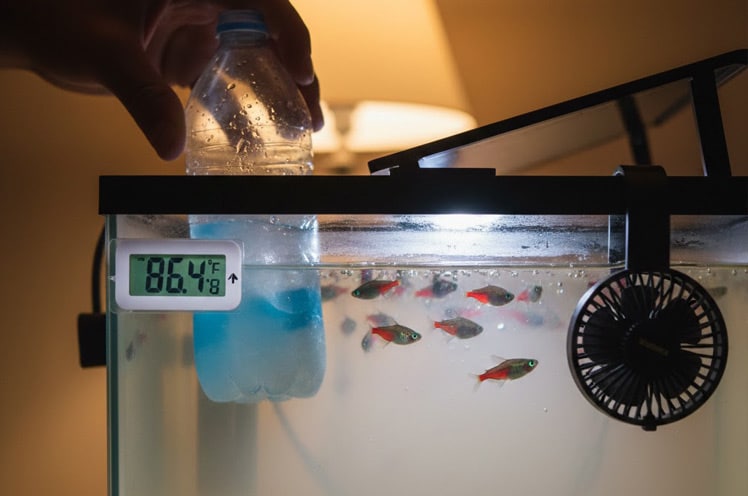
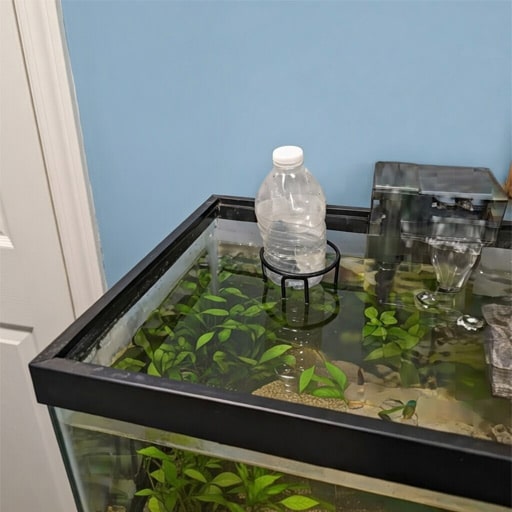
- How I Do It: Fill a clean plastic water bottle with dechlorinated water and freeze it. I float the sealed bottle in my tank, or I place it in my filter’s back chamber.
- Pro-Tip: Never use loose ice cubes. They often contain chlorine from tap water and can cause a “cold spot” in the tank that shocks fish. I keep two 20-oz bottles in my freezer at all times, just in case there is a power outage where my fans won’t work.
Important Note: Watch Your Flow
A frozen bottle only works safely if your tank has decent circulation. In a tank with weak flow, the area immediately around the bottle can get dramatically colder than the rest of the tank — creating a localized cold pocket instead of an even temperature drop. Any fish that swims right up next to it can experience the same kind of shock you’re trying to avoid in the first place. If your filter output is weak or you’re working with a still corner of the tank, position the bottle somewhere with active water movement — near the filter outflow is ideal — so the cold disperses evenly instead of pooling in one spot.
Method 2: Using A Fan
If you need to drop the temp by 4-5 degrees and keep it there, you need a fan.
- How I Do It: I started with a simple desk fan pointed across the water surface, which works fine in a pinch. These days, I use dedicated, purpose-made aquarium fans instead — they’re built to run continuously without the wobble or noise of a desk fan repurposed for the job.
- The Science of How It Works: This works through the physics of evaporation. As water turns to vapor, it pulls heat away from the tank.
- Quick Note: You will see your water level drop faster, so be ready to top off with treated water more frequently than usual. Heads up — this concentrates minerals over time, the same way evaporation does between water changes, so if you’re running fans for more than a few days, it’s worth reading my guide on reducing aquarium water hardness before your top-off water starts working against you.
When Fans May Not Be Enough: Understanding Aquarium Chillers
Everything in this guide so far works through evaporation — you’re helping heat escape faster, not actually pulling it out of the system. For an occasional heatwave, that’s plenty. But if you’re fighting hot water for months at a stretch, live somewhere with no real “cool season,” or you’re running a reef or Discus tank with almost no margin for error, evaporation alone usually isn’t enough.
That’s where an aquarium chiller comes in. Think of it as a heater running in reverse: instead of warming water, it actively pulls heat out through a refrigeration compressor — the same basic principle as your home AC or refrigerator. Water gets pumped through the unit, cooled, and returned to the tank, completely independent of how hot or humid the room around it is.
The tradeoff is cost and complexity. A decent in-line chiller starts in the $150–$300+ range, needs to be plumbed into your filtration (usually a canister filter or a dedicated pump loop), and adds one more piece of equipment that can fail. For most fishkeepers dealing with a seasonal heatwave, that’s overkill — the methods above will get you through. But if you’re losing the same battle every single day for months, a chiller stops being a luxury and starts being the actual fix, instead of patching the same leak every afternoon.
IMPORTANT NOTE: If you’re keeping axolotls, treat this section differently than the rest of this guide. Axolotls need 60–68°F consistently — well below what evaporative cooling (fans, frozen bottles) can reliably hold once ambient room temps climb into the 80s. For axolotls, a chiller isn’t a ‘someday’ upgrade for chronic heat — it’s close to mandatory gear in most climates, not just an emergency backup.
Riding Out a 3-Day Heatwave Without An Aquarium Chiller
Riding Out a 3-Day Heatwave Without An Aquarium Chiller
Day 1, Hour 0: A heatwave hits, no AC running. The tank thermometer reads 86°F — past the 82°F emergency line.
Hour 0-1: Emergency Checklist runs immediately: heater unplugged, lights off, lid cracked for airflow, air stone added for the oxygen loss that comes with hot water.
Hour 1: A frozen bottle goes in near the filter outflow, and a fan gets aimed across the surface — both methods running together.
Hour 1-5: Hourly checks show a steady drop: 86°F → 85°F → 84°F → 83°F → 82°F. About 1°F per hour — comfortably inside the 1-2°F speed limit, with room to spare.
Overnight: The fan runs continuously; the tank settles at 80°F by morning. Water level drops faster than usual, so a top-off with pre-treated water happens before bed.
Day 2: Maintenance mode — fan and air stone stay on, temperature holds at 79-80°F. A second frozen bottle goes in during the hottest afternoon stretch as extra insurance.
Day 3: As the room cools, the tank drifts back to 78°F on its own. The heater goes back in gradually, not all at once.
The takeaway: No chiller needed — three days of fan-plus-bottle handled the whole event safely, at a pace well within the safe cooling range the whole way through. That’s the line from the chiller section above: occasional heatwaves are exactly what evaporative methods are built for. A weekly repeat of this, month after month, is when the math shifts toward active cooling instead.
Best Tools For Cooling Fish Tank Water That I’ve Used In My Fish Room
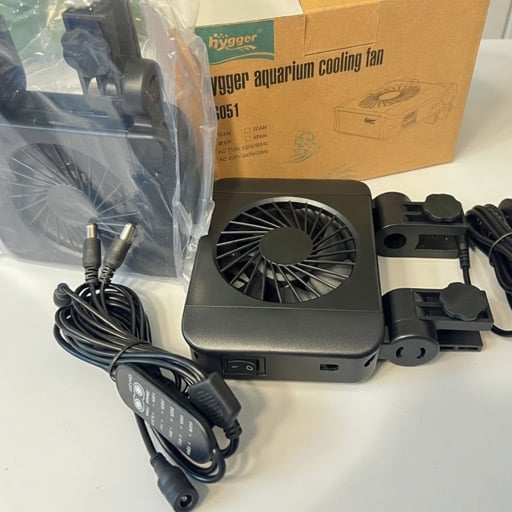
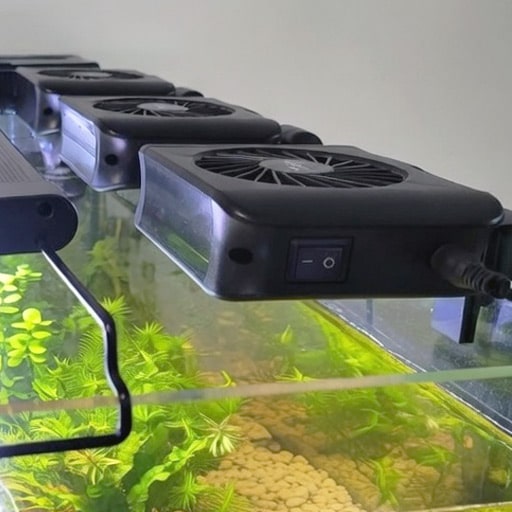
Hygger Clip-On Fan
How I Use Them: I use these on my 20-gallon long. They are effective and inexpensive. They aren’t the quietest fans on the market, but if it’s 90 degrees in the house, I’ll take a little hum over dead fish any day.
- What I like: They are super effective at cooling down my tank when I need them!
- What I Don’t Like: Other than the noise level, tanks with a thick rim around the top can be a problem for these fans to clip onto properly.
- Cost: About $20 for 1 fan or about $35 for the 3-fan setup
- 4.3 Stars (427 Amazon Reviews)
Paizoo Aquarium Cooler
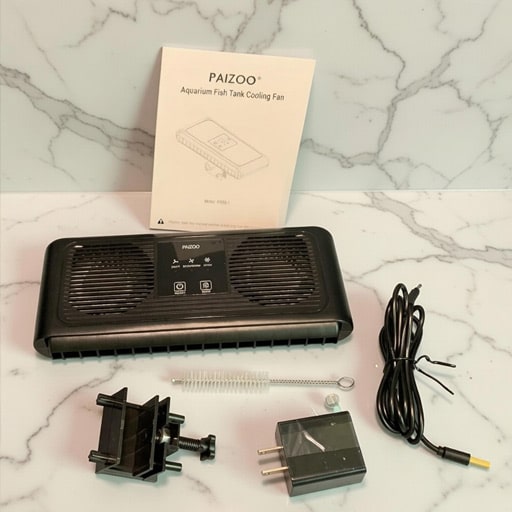
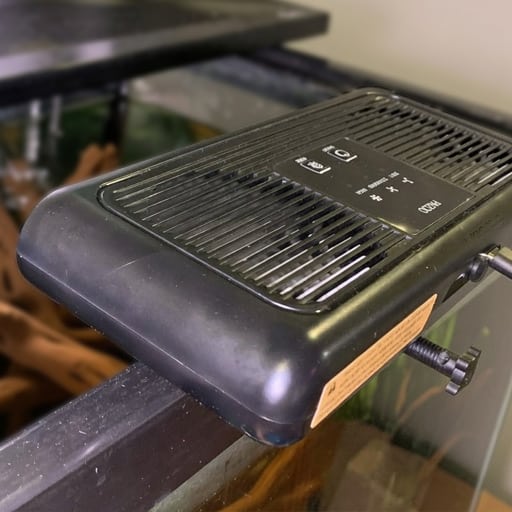
How I Use It: Once the weather starts to get hot, I pull this thing out and put it on the tank in case I need it. It’s best to place it on the opposite side of the tank from your filter so you can cool the water pouring back into your tank.
- What I Like About It: It’s great for peace of mind because you can see the degrees dropping in real-time.
- What I Don’t Like About It: This fan feels kind of cheap. So far, I’ve only used this fan for maybe two weeks’ worth of time, but it does work great. How long will it last? Who knows.
- Cost: About $25.00
- 4.3 Stars (332 Amazon Reviews)
Check Out These Other Great Posts
How To Cool Fish Tank Water FAQs:
Can I just do a cold water change to cool my tank’s water?
Be very careful. A 10% water change with slightly cooler water is okay. A large cold water change can shock your fish’s immune system — peer-reviewed research confirms temperature stress is a key predisposing factor for ich outbreaks by compromising fish immune response — and lead to Ich outbreaks.
Is 82°F too hot for a Betta?
Bettas like it warm (78-80°F), but once you hit 84°F+, they start to struggle. Keep a close eye on them; if they are lethargic or gasping, it’s time to cool it down.
Will a fan make my fish tank water harder?
Yes, slightly. Because only pure water evaporates, the minerals stay behind. If you are cooling with fans for weeks, you may need to use some RO/DI water for top-offs — and if your tap water already runs hard, it’s worth reading my guide on reducing aquarium water hardness so you’re not fighting two problems with the same top-off water.
Can I use a regular house fan to cool my fish tank?
Absolutely. If it’s an emergency, any fan blowing across the surface will help. Just be careful about the fan falling into the water!
How fast is too fast when cooling fish tank water?
Be very careful. A 10% water change can work, but only if the replacement water is close to the tank’s current temperature — within a degree or two, checked with a thermometer, not by feel. A 10% change with water that’s significantly colder than your tank can still blow past the 1–2°F-per-hour speed limit on a smaller tank, leading to the same Ich-triggering immune shock you’re trying to avoid.
Should I unplug my fish tank heater in the summer?
You don’t have to if you have a reliable heater, but many hobbyists unplug them during heatwaves just in case the thermostat gets stuck on.
Do plants help or hurt in the heat?
Plants actually help! They provide shade and use up nutrients that would otherwise fuel the algae bloom that often follows a heatwave.
Why is my fish tank water cloudy during a heatwave?
Heat accelerates bacterial growth. You might be seeing a bacterial bloom. Increase your oxygenation and check your nitrate levels immediately.
Are some fish more sensitive to heat?
Yes. Cool-water fish like Goldfish or White Cloud Mountain Minnows will struggle much sooner than tropical cichlids.
What if I have a lid on my fish tank and can’t use a fan?
You can prop the lid open using a small block of wood or a plastic bottle cap. Even a 1-inch gap for airflow makes a massive difference.
Final Thoughts On Cooling Your Fish Tank Water
The logic of cooling your aquarium is about gradual change. In my 15 years, I’ve seen more fish lost to “temperature shock” from owners dumping ice into the tank than from the heat itself. You have to work with physics. Whether you’re using a high-end Aquarium Chiller for a specialized setup or just a simple desk fan for your nano tank, the goal is a slow, steady decline that allows your livestock to acclimate.
In my own fish room, I prioritize passive cooling first—lids open, lights raised, and increased aeration. If you find yourself in a heatwave emergency, use the “Frozen Bottle” method I’ve outlined, but always keep an eye on your thermometer. Consistency is the hallmark of a veteran hobbyist. By understanding the relationship between air movement and water temperature, you can keep your AquaLogic system stable even when the thermometer outside is climbing.
Have a cooling trick I missed? Or is your tank currently spiking? Drop a comment below, and I’ll jump in to help the best that I can!

I founded AquaLogicHQ to share hands-on, tested strategies that come from 3-month algae battles and countless hours perfecting the nitrogen cycle. My mission is simple: I've made most of the mistakes on my four active tanks and am sharing the answers so you can avoid disaster in yours. When I’m not elbows-deep in a water change, I’m putting the latest hobby gear through its paces to see if it actually delivers.
- Best Fish for a Nano Tank: 8 Species That Actually Thrive - September 8, 2026
- Best Shrimp Tank Starter Kits (2026 Guide) - August 31, 2026
- How Many Fish Can You Put in a 20 Gallon Tank? - August 19, 2026