Updated 26 July 2026
The simplest calculations matter for the long-term health of your tank. One of the most common questions I get from beginners setting up their first fish tank is, ‘How much gravel do I actually need?’ It’s not just about aesthetics; it’s about providing enough depth for your Starter Bacteria to thrive and your plants to root. After 15 years of scaping everything from nano tanks to 50-gallon communities, I’ve developed a logical formula to ensure you don’t end up with a ‘sand desert’ or a substrate bed so deep it traps toxic gases.
The TLDR Fast Facts For Substrate Calculation:
- The Real Rule: Footprint, Not Gallons. Two tanks with the same water volume can need very different amounts of substrate. A 20-gallon Long and a 20-gallon High hold the same water, but the Long has more floor space — 33 lbs vs. 26 lbs for a standard 2-inch bed. Always calculate from length × width, not gallon count.
- The Formula: (Length × Width × Depth, all in inches) ÷ 22 = pounds of substrate needed. Use the calculator below to skip the math entirely.
- The Quick Ballpark (rough estimate only): If you just want a fast mental number before you get to a calculator, 1.5 lbs per gallon is close for a standard 2-inch bed — but it’s an average, not a real measurement. Two same-size tanks with different shapes will throw this off.
- The Planted Upgrade: Root-feeding plants like Amazon Swords need a deeper bed — plan for about 3 inches instead of 2, which works out to roughly 2 lbs per gallon as a rough guide, or your exact number from the formula.
- The Active Soil Exception: Lightweight volcanic soils like Fluval Stratum need about 50% less weight than heavy river stone or standard gravel to hit the same depth — weight and volume aren’t the same thing.
- The Deep Bed Warning: Never let fine sand exceed 2 inches without tilling it occasionally, or you risk anaerobic dead zones that trap toxic hydrogen sulfide gas.
Disclosure: AquaLogicHQ.com is a participant in the Amazon Services LLC Associates Program, as well as other affiliate programs, designed to provide a means for us to earn fees by linking to Amazon.com and affiliated sites at no extra cost to you. Please see the Affiliate Disclosure for more details.
The Quick Gravel Math
If you just want a fast ballpark before running the real numbers, this rough ratio works for most beginner tanks (5 to 29 gallons):
- Standard Tank: about 1.5 lbs of gravel per gallon of water.
- Planted Tank: about 2 lbs of substrate per gallon of water.
Treat this as a starting estimate, not a shopping list. As I’ll show you below, two tanks with the exact same gallon count can need different amounts depending on their shape — so once you know your tank’s actual footprint, use the calculator further down for your real number.
The Tank Size Substrate Weight Cheat Sheet
This chart shows the rough estimate in pounds of standard quartz gravel and/or sand required to hit a baseline 2-inch depth versus a deeper 3-inch planted bed.
| Tank Size | Standard Setup (2″ Depth) | Planted Setup (3″ Depth) |
|---|---|---|
| 5 Gallon (16×8) | 11.5 lbs | 17.5 lbs |
| 10 Gallon (20×10) | 18 lbs | 27 lbs |
| 20 Gal Long (30×12) | 33 lbs | 49 lbs |
| 20 Gal High (24×12) | 26 lbs | 39 lbs |
| 29 Gallon (30×12) | 33 lbs | 49 lbs |
| 40 Breeder (36×18) | 59 lbs | 88 lbs |
| 55 Gallon (48×13) | 57 lbs | 85 lbs |
| 75 Gallon (48×18) | 79 lbs | 118 lbs |
Note: For 40-breeder and 75-gallon setups, the floor footprints are wider, meaning they require more raw weight to achieve the same vertical depth than narrower tanks.
The Manual Aquarium Substrate Calculator Formula
If you have a custom rimless tank, a bowfront, or want to calculate your needs based on exact inches rather than standard volumes, use my logical substrate calculation formula.
To find out exactly how many pounds of standard aquarium gravel or sand you need for a 2-inch bed, multiply your tank’s dimensions using this simple math:
(Tank Length in Inches × Tank Width in Inches × Desired Depth in Inches) ÷ 22 = Total Pounds of Substrate Needed
The Calculator Formula in Action:
Let’s calculate the needs for a standard 10-gallon tank (20 inches long by 10 inches wide) at a standard 2-inch depth:
- Multiply Length × Width × Depth: 20 × 10 × 2 = 400
- Divide the result by 22: 400 ÷ 22 = 18.1
This tells us you need about 18 lbs of substrate, which matches our cheat sheet perfectly! Use this formula for any rectangular footprint to buy exactly what your ecosystem requires.
Got a Bowfront or Curved-Glass Tank?
The formula above assumes a straight rectangular footprint. If your tank has a curved bowfront, that extra glass belly adds real floor space the flat length × width math doesn’t capture — which means the standard formula will slightly undercount what you actually need.
The fix: run the numbers through the formula as normal, then add 10-15% to your result to account for the curve. So if the rectangular formula says you need 33 lbs, plan on roughly 37-38 lbs for a bowfront of the same overall dimensions. It’s not exact to the inch, but it’s close enough to avoid coming up short with wet hands and an unfinished aquascape.
Aquarium Substrate Calculator: Find Your Exact Amount
Now that you know the math behind it, use this calculator to get your exact number. Enter your tank’s dimensions or pick a common size from the dropdown — it uses the same formula above.
The AquaLogicHQ.com Aquarium Substrate Calculator
Enter your tank dimensions or pick a common size to find out exactly how many pounds of gravel or sand you need.
Bookmark this page — it’s the quickest way to check your substrate math before your next tank setup.
Why Substrate Volume Matters for More Than Just Looks
Here’s something most substrate guides skip entirely: the gravel or sand sitting on your tank floor isn’t just decoration — it’s physically displacing water. A “20-gallon” tank with 2 inches of substrate doesn’t actually hold 20 gallons of water anymore. It holds less, because the substrate is taking up space that would otherwise be water.
Why this actually matters:
If you dose medication, water conditioner, or fertilizer based on your tank’s labeled volume, you could be slightly overdosing once substrate, decorations, and hardscape are factored in. For most community tanks with a standard 2-inch bed, the difference is small enough not to worry about. But on a heavily aquascaped tank with a deep substrate slope, large driftwood, and rockwork, the real water volume can run meaningfully lower than the number on the box — sometimes 10% or more.
The quick way to check:
The roughest estimate is that 1 gallon of standard gravel displaces close to 0.1 gallons of water — so a tank running 30 lbs of substrate is losing somewhere in the neighborhood of half a gallon to a gallon of actual water volume, depending on material density. For most everyday dosing, this level of precision doesn’t matter. But if you’re treating a sensitive species, dosing something with a narrow safety margin, or running a heavily scaped tank, it’s worth using your actual water volume rather than the number printed on the tank, especially for anything measured by the drop.
The simplest fix:
Fill your tank with substrate and hardscape first, then measure how much water it actually takes to fill it before adding fish. That real number is more useful for dosing than any calculator estimate — substrate is just one piece of what’s displacing water in a fully decorated tank.
Why The “Pounds Per Gallon” Rule Sometimes Fails
Here’s a little secret: weight does not equal volume. If you buy heavy river stones, 20 lbs might only cover the bottom of a 10-gallon tank. If you buy lightweight volcanic soil (like Fluval Stratum), that same 20 lbs might fill that tank halfway up.
How I test it: I always buy one bag more than I think I need. If I don’t use it, I keep it in my “fish room” for future setups. As a rule of thumb, round your calculated total up by 10-20% — that covers slope, rinsing loss, and natural settling, so you’re not stuck mid-setup with wet hands and an empty bag.
Don’t lean too hard on the “1.5 pounds per gallon” rule from earlier in this guide — it’s a useful ballpark, but it’s not the real answer. The logic I actually use is based on footprint, not volume. A 20-gallon “High” and a 20-gallon “Long” hold the exact same amount of water, but they have vastly different floor space — which is why one needs 26 lbs and the other needs 33 lbs for the same 2-inch depth, even though they’re both “20 gallons” on paper. I’ll show you how to calculate based on your tank’s actual dimensions so you get that perfect depth every time, instead of guessing from the gallon number on the box.
3 Factors That Change Your Gravel Needs
1. The “Slope” Illusion
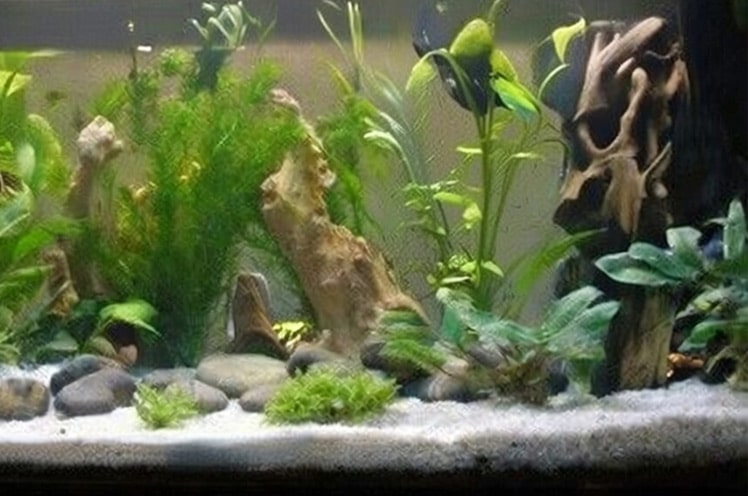
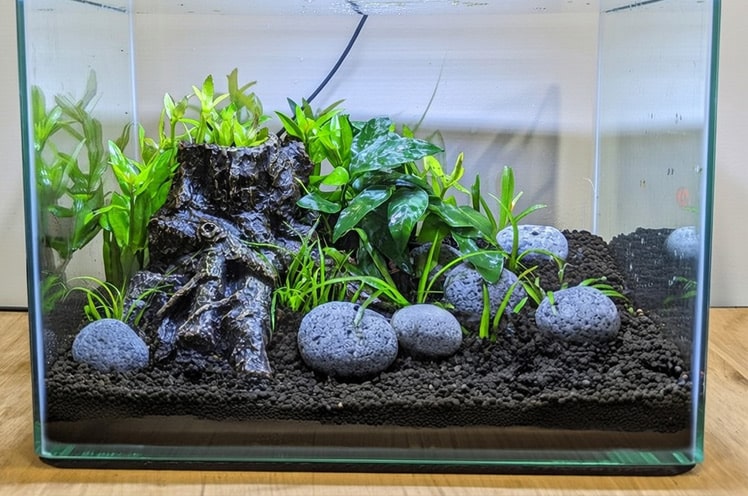
I never lay my gravel flat. I always slope it from 1 inch in the front to around 3 inches at the back. This creates a logical sense of depth and perspective in your aquascape, and it’s where I tuck my heavy-rooting plants for maximum stability.
- Why? It creates an illusion of depth that makes your tank look much larger. It also makes waste (detritus) roll toward the front, where it’s easier to suck up with your water change pump.
2. Root Depth for Plants
If you are using live plants like Amazon Swords, they need about 3 inches of substrate to stay anchored. In my 20-gallon long aquascape, I use a deeper bed of Aqua Soil specifically to support my heavy root-feeders.
3. Under-Gravel Filters
If you are using an old-school under-gravel filter (which I don’t usually recommend for beginners), you must have at least 2 inches of gravel to ensure the water pulls through the bed evenly.
How to Set Up Your Gravel (The Clean Way)
Step 1: The Bucket Rinse
Never pour gravel straight from the bag into the tank. It is covered in dust that will turn your water into “milk” for days.
- How I do it: I fill a 5-gallon bucket 1/3 full of gravel and run a garden hose into it. I stir it by hand until the water overflowing the bucket is crystal clear.
Step 2: Design and Create Your Slope
Get your gravel into the tank and start shaping it. My standard approach is to slope it from about 1 inch at the front glass to 3 inches at the back — this creates a natural sense of depth and perspective that makes even a 20-gallon look like a much larger aquascape. I’ll often add my larger rocks and hardscape pieces first as anchor points, then pack the substrate around and behind them to lock everything in place before the water goes in.
Don’t stress about getting it perfect at this stage. Once you start filling (see Step 4), the water movement will settle things slightly anyway. I usually do a rough layout first, step back, look at it from the front glass at eye level, adjust, then fill. The eye-level view is the one that actually matters — that’s what you and your fish will see every day.
What I do: A lot of times, I add the gravel to the tank without any idea of how I want it to look and just move it around until it feels good. Then I start to fill the tank with water.
Step 3: The “Smell Check” For Safety Verification
Before I add gravel to my fish tank, I give it a quick smell first. If it has a chemical or “plastic” scent, I rinse it again with hot water. High-quality gravel should be odorless.
Step 4: The Filling Method
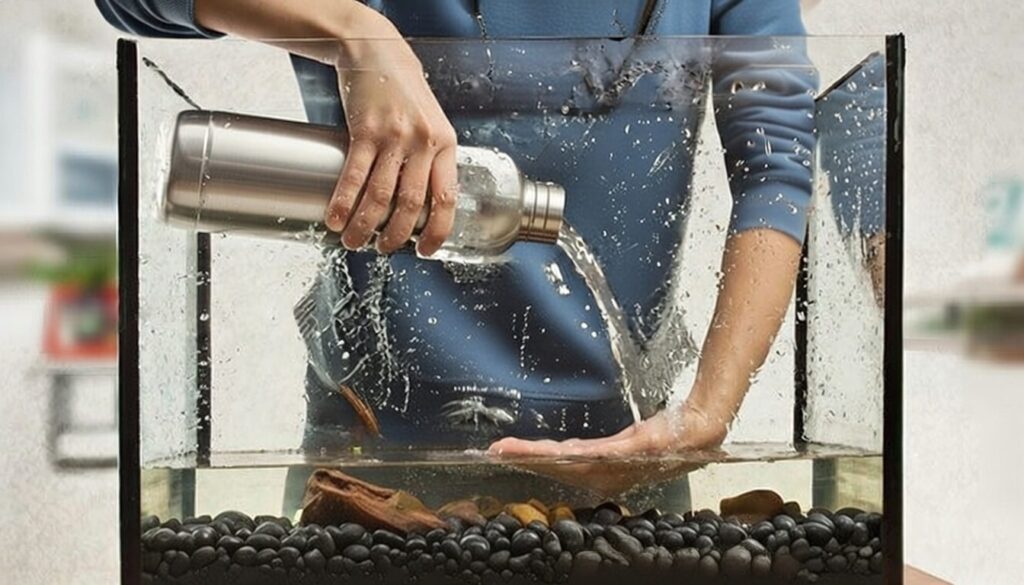
When filling the tank, I like to use my hand as I pour the water on the edge of the glass over the new gravel. When I pour the water on my hand, it prevents the water pressure from blasting a hole in the perfect slope of the new gravel.
Some people use a dinner plate on top of the gravel, and some people use a slow method of gently pouring water evenly and slowly.
How Much Aquarium Gravel Do I Need FAQs
How deep should my gravel be?
For most tanks, 2 inches is the Goldilocks zone. It’s deep enough to hold decorations but shallow enough to prevent “Dead Zones” where toxic gas can build up. (See my guide on stinky fish tank water if you’re worried about this).
Is sand better than gravel?
It depends on your fish! If you have Corydoras or Loaches, sand is better because it won’t scratch their bellies. For beginners, gravel is easier to clean with a siphon vacuum.
Can I use gravel from my driveway?
Please don’t. Driveway gravel often contains limestone or oily residues that will spike your pH and kill your fish. Only use gravel labeled aquarium-safe.
How often should I clean my gravel?
I vacuum 25% of the gravel surface during every weekly water change. Don’t do the whole tank at once, or you’ll remove too much of the good bacteria.
Why is my gravel turning green?
This is algae. It usually means your lights are on too long or you are overfeeding. Check out my Algae Removal Guide for the fix.
Will gravel change my pH?
Natural quartz gravel won’t, but Aragonite or Crushed Coral will skyrocket your pH. Always check your levels with a liquid test kit.
Can I add more gravel to an established tank?
Yes, but rinse it thoroughly first! Add it a handful at a time to avoid trapping your fish or clouding the water.
Do I need to replace my gravel?
Unless you are using an active plant soil that breaks down over time, you never need to replace gravel. Just keep it clean!
What is the best color for fish?
I prefer darker gravels (black or dark brown). Fish feel more secure on dark floors, and their colors pop much more than they do on bright, neon colors.
How do I stop my gravel from being sucked into the vacuum?
Use a vacuum with a wide cylinder. The weight of the gravel will cause it to fall back down while the lighter waste gets sucked away.
Final Thoughts: Don’t Overthink Gravel
Calculating your substrate needs is the first step in building a stable biological foundation. In my 15 years, I’ve seen too many hobbyists eyeball it and end up with a shallow bed that can’t support a cycle, or a massive 5-inch pile that creates dangerous anaerobic “dead zones.” The logic is simple: you want enough depth to anchor your decor and house your bacteria, but not so much that maintenance becomes a nightmare.
That’s exactly why I stopped trusting the “gallons” on the box and started measuring the floor. Run your own tank through the calculator above — you might be surprised how different two “same-size” tanks really are. A 20-gallon Long and a 20-gallon High hold the same water, but one needs a quarter more substrate than the other just to hit the same 2-inch depth. The gallon number on the box was never going to tell you that.
In my 50-gallon community, I aim for a consistent 2-to-3-inch bed to allow for easy gravel vacuuming. If you’re planning a high-tech planted tank in a 20-gallon long, you might go deeper with specialized soils. Whatever your goal, use the math to buy exactly what you need. Getting the substrate volume right from day one means a cleaner tank, healthier plants, and a maintenance routine that actually makes sense.
How deep are you going? Drop a comment below with your tank size and what fish you’re keeping — I’ll let you know if your gravel math checks out!

I founded AquaLogicHQ to share hands-on, tested strategies that come from 3-month algae battles and countless hours perfecting the nitrogen cycle. My mission is simple: I've made most of the mistakes on my four active tanks and am sharing the answers so you can avoid disaster in yours. When I’m not elbows-deep in a water change, I’m putting the latest hobby gear through its paces to see if it actually delivers.
- Best Canister Filters For Fish Tanks: What I’d Actually Buy for a Big Tank - July 26, 2026
- The Best Nano Aquarium Tanks I’ve Actually Run in My Fish Room - July 19, 2026
- The Best Fish Tank Heaters: Ranked and Sized for Your Setup - July 4, 2026