Updated 27 June 2026
I see aquarium fertilizers as the ‘fuel’ for your underwater jungle. Many beginners make the mistake of dumping chemicals into the water and wondering why they have an algae bloom instead of plant growth. After 15 years of balancing nutrients in everything from my low-tech 50-gallon community to a high-intensity 20-gallon long, I’ve learned that the logic of fertilization isn’t about more—it’s about consistency. In this guide, I’m breaking down the exact schedule I use to keep my plants thriving and my water crystal clear.
The TLDR Aquarium Fertilizer Dosing Cheat Sheet:
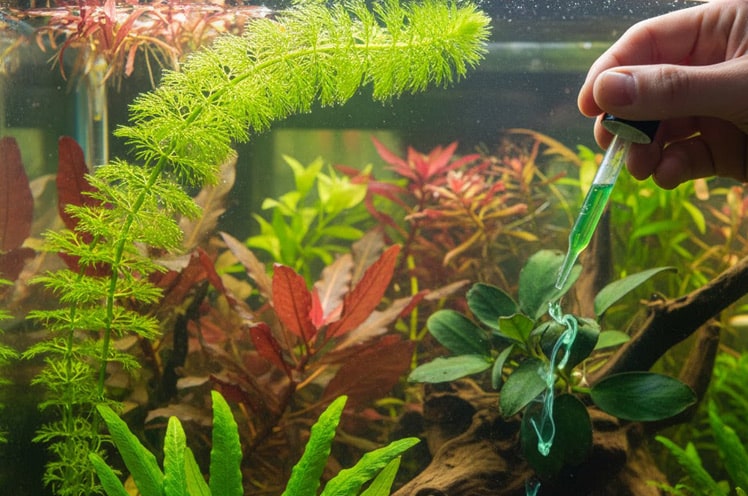
- The Cardinal Dosing Rule: Always apply liquid fertilizers after a water change, never before. Dosing before a maintenance session means you are siphoning your expensive nutrients straight down the drain.
- High-Stock Community Tanks: Dose liquid fertilizer once per week immediately after your weekly water change. Your fish waste provides natural nitrates; adding more frequently triggers algae.
- Low-Stock heavily Planted Tanks: Dose liquid fertilizer 2 times per week (e.g., Saturday and Wednesday) to ensure dense stem plants or floaters don’t starve for macronutrients.
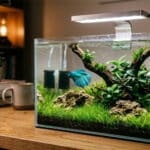
- Nano & Betta Tanks: Dose slow-growers (Anubias, Java Fern) once every 2 weeks, or administer a half-dose weekly to keep small water volumes stable.
- Heavy Root-Feeders (Swords, Crypts): Bury Root Tabs deep into your substrate directly beneath the roots every 2 to 3 months.
| Product | Best For | Price | |
|---|---|---|---|
| Seachem Flourish | Micronutrient pop in tanks with fish-supplied nitrates | ~$11 | Check price |
| API Leaf Zone | Fixing yellowing leaves, Iron & Potassium boost | ~$12 | Check price |
| API Root Tabs | Heavy root-feeders like Swords and Crypts | ~$10 | Check price |
Disclosure: AquaLogicHQ.com is a participant in the Amazon Services LLC Associates Program, as well as other affiliate programs, designed to provide a means for us to earn fees by linking to Amazon.com and affiliated sites at no extra cost to you. Please see the Affiliate Disclosure for more details.
When to Start Fertilizing a New Tank
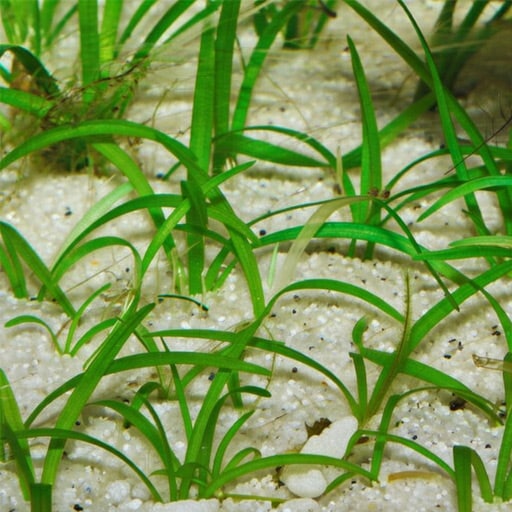
A lot of beginners assume they should wait until the tank’s established before adding fertilizer — that’s backward. New plants haven’t built root systems yet, so they’re relying on their leaves to pull in nutrients directly from the water column. If you wait, you’re starving them right when they’re most vulnerable.
My rule: start dosing on day one, but at half-strength for the first two weeks while the plants settle in. Once you see new growth, that’s your sign to move up to a full dose.
How Often to Dose Fertilizer Based on Your Tank Setup
Not all plants eat the same way. The logic I use? If it has a heavy root system like a Cryptocoryne, it needs Root Tabs. If it’s a water-feeder like Anubias, it needs liquid fertilizer. I’ll show you how to identify your plant’s ‘feeding style’ so you aren’t wasting money on the wrong products.
Find the profile that matches your setup:
1. The Low-Stock / Heavy Planted Tank
- The Setup: Lots of stem plants or floaters, but only a few small fish (like a 20-gallon long with a school of tetras).
- Frequency: 2 times per week.
- Why I Do It This Way: There isn’t enough fish waste (nitrates) to feed all those plants. I need to supplement the “macros” more often.
2. The High-Stock / Community Tank
- The Setup: A busy tank like my 50-gallon community with plenty of fish.
- Frequency: Once a week (after a water change).
- Why I Do It This Way: My fish are doing half the work for you. Over-fertilizing here is a recipe for an algae explosion.
3. The Nano Betta Tank
- The Setup: Small volume, slow growers like Anubias or Java Fern.
- Frequency: Once every 2 weeks (or half-doses weekly).
- Why I Do It This Way: These plants grow slowly and don’t “eat” as fast. Excess nutrients in a small tank can crash your water quality quickly.
4. Heavy Root-Feeding Tanks
- The Setup: Tanks with heavy root-feeders like Amazon Swords, Crypts, or Vallisneria, regardless of how many fish you’re running.
- Frequency: Every 2 to 3 months (Root Tabs).
- Why I Do It This Way: These plants pull most of their nutrients through their roots, not the water column. Liquid fertilizer barely reaches them — Root Tabs buried near the root system deliver nutrients exactly where they’re needed.
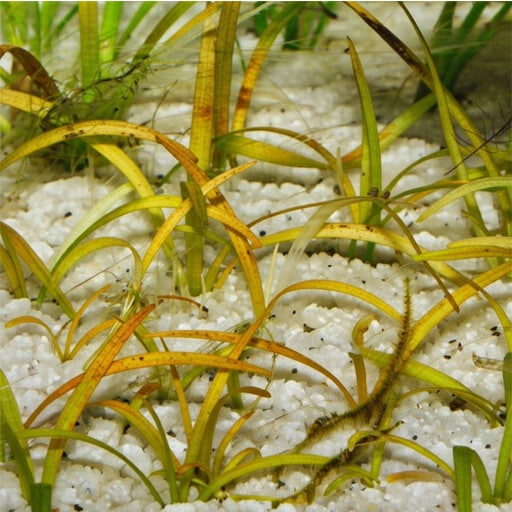
Identifying “Hungry” Plants: Liquid vs. Root Tabs
Different plants eat in different ways. Knowing the difference changes how often you fertilize.
| Fertilizer Type | Best For | How Often? |
| Liquid All-in-One | Floating plants, Moss, Java Fern | 1–2 times per week |
| Root Tabs | Amazon Swords, Crypts, Vallisneria | Every 2–3 months |
- Quick Fertilizer Tip: I always keep a fast-grower like Hornwort or Water Sprite in my tanks. If the tips of these plants stop growing or turn pale, I know the whole tank is hungry, even if my slower Anubias looks fine.
Aquarium Plant Deficiency Symptom Table
| Symptom | Likely Deficiency |
|---|---|
| Older leaves are yellowing, especially at the tips | Nitrogen |
| New growth pale or yellow, with darker veins | Iron |
| Small pinholes forming in leaves | Potassium |
| Stunted growth, unusually dark green leaves | Phosphorus |
| Plants are growing, but won’t hold color | Micronutrients (try Flourish) |
The Best Plant Fertilizers for Aquarium Use
After testing dozens of brands over the last 15 years, I’ve narrowed it down to three staples that I keep in my fish room. Here is when (and why) I use each one.
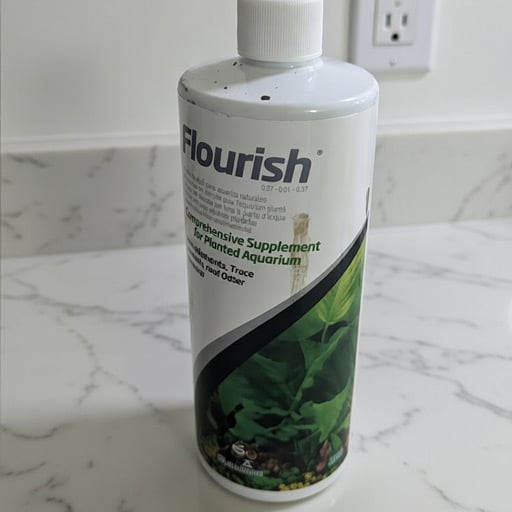
1. Seachem Flourish (The “Micronutrient” Specialist)
- Best For: Low-light tanks with Anubias, Java Fern, and Mosses.
- My Take: Many beginners mistake this for a “complete” food. In reality, Flourish is heavy on Micro-nutrients (Iron, Manganese, etc.) but very light on Macro-nutrients (Nitrogen/Phosphorus). I use it to give plants a vivid pop of color when fish waste already provides baseline nitrates.
- How I use it: I use this in my 50-gallon community tank where the fish provide plenty of Nitrogen, but the plants need that extra “pop” of color and health.
- Cost: About $11
- 4.6 Stars (5,511 Reviews)
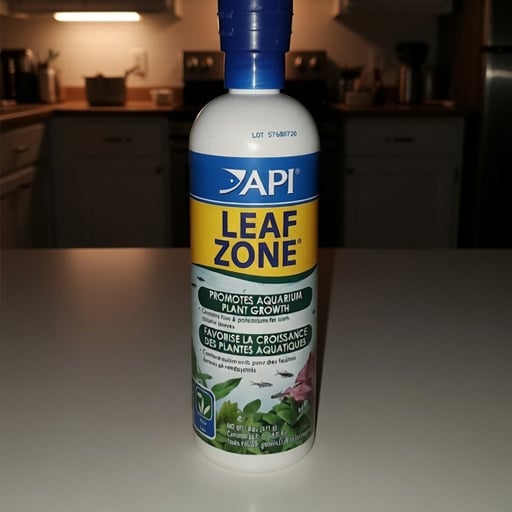
2. API Leaf Zone (The Simple “Iron & Potash” Boost)
- Best For: Fixing yellowing leaves and strengthening stems.
- My Take: If you see your plants getting “holey” (pinholes in leaves) or turning pale yellow, Leaf Zone is a lifesaver. It focuses heavily on Iron and Potassium.
- How I use it: I dose this mid-week in my 20-gallon long if I notice my stem plants are looking a bit “leggy” or weak. It’s very hard to mess up and very safe for beginners.
- Cost: About $12
- 4.6 Stars (7,855 Reviews)
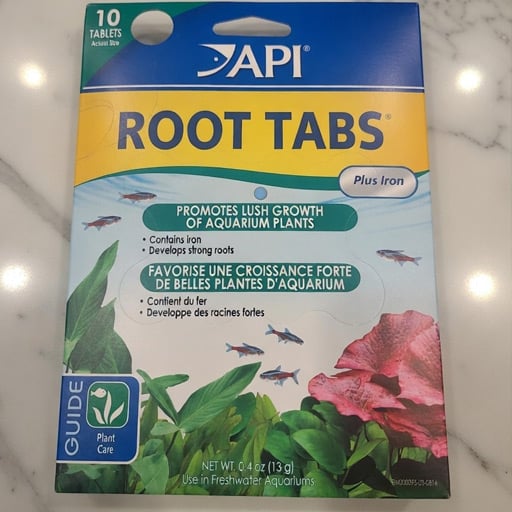
3. API Root Tabs (The “Ground” Game)
- Best For: Amazon Swords, Crypts, and Vallisneria.
- My Take: If you have plants with heavy root systems, liquid fertilizer alone won’t cut it. You have to feed them through the substrate.
- How I use it: I bury one tab every 4–6 inches in the gravel around my heavy feeders every 2 to 3 months.
- Pro-Tip: Make sure you push them all the way to the bottom glass. If they sit on top of the gravel, they will dissolve too fast and can cause an algae spike in the water column.
- Cost: About $10 for a 10-pack
- 4.5 Stars (5,938 Reviews)
How to Combine Them (The Strategy)
For a Basic Tank: Start with Seachem Flourish once a week.
If you see yellowing: Switch to or add API Leaf Zone to get that Iron boost.
If you have big “Leafy” plants: Use API Root Tabs in the gravel PLUS Flourish in the water. For the easiest plant options that you can add to your tank, see my post on the best plants for beginners to make life as easy as possible.
My “Fish Room” Routine
My Fish Room Routine, with the tank now named explicitly:
I’ve found that consistency is more important than the exact day. Here is my current schedule for my 20-gallon long:
- Saturday (Maintenance Day): I do a 30% water change to reset the tank. Afterward, I add a full dose of liquid fertilizer.
- Wednesday (Mid-Week Check): I check my nitrate levels. If they are below 10ppm, I add a half-dose of fertilizer to keep the plants from staling.
Quick Tip: The #1 cause of algae isn’t fertilizer — it’s an imbalance. If you add nutrients but don’t have a light specifically for a planted tank to help the plants process them, the algae will eat the leftovers. I follow the logic of “Liebig’s Law of the Minimum” — the idea that growth is limited by whichever single nutrient is scarcest, not by the total amount you add — to make sure my plants have exactly what they need, and not a drop more.
CO2: The Nutrient Most People Forget
I follow the logic of ‘Liebig’s Law of the Minimum‘ — a 19th-century agricultural science principle stating that growth is limited by whichever single nutrient is scarcest, not by the total amount you add — to make sure my plants have exactly what they need, and not a drop more.
If you’re dosing a full fertilizer schedule but your plants still aren’t growing, low CO2 is one of the most common reasons why: the plants simply can’t use the nutrients you’re adding fast enough, and the leftovers become exactly what algae needs to take over.
You don’t need a pressurized CO2 system to benefit from understanding this. Low-tech tanks with low-light, slow-growing plants (Anubias, Java Fern, Java Moss) get by fine on the trace CO2 already in the water column. But the moment you’re running stronger lighting or fast-growing stem plants, that natural CO2 supply often becomes the real bottleneck — not whatever fertilizer you just bought.
Top 10 Fertilizer FAQs
Should I fertilize before or after a water change?
Always after. If you fertilize before, you’re literally pouring money down the drain when you siphon out the old water.
Is it possible to over-fertilize?
Yes. If you add more nutrients than your plants can use, the leftovers become food for algae. If you see an algae bloom, check my algae removal guide.
Does fertilizer hurt my shrimp or snails?
Most aquarium fertilizers are safe for invertebrates, but look for shrimp-safe on the label if you are keeping sensitive species. The tiny amount of copper in most all-in-ones is usually not enough to harm them.
Why are my plants melting after I started fertilizing?
If they are new, they are likely just adapting to your water. If they are established, you might be dosing too much, causing a nutrient burn.
Do I need fertilizer if I have a lot of fish?
Fish waste provides nitrates, but it doesn’t provide Micronutrients like Iron or Potassium. You still need a light dose of an all-in-one to fill those gaps.
What is the best time of day to fertilize?
Morning (or whenever your aquarium lights turn on). Plants only eat fertilizer when they have light to photosynthesize.
Can I just use houseplant fertilizer?
No! Houseplant fertilizers often contain urea and high levels of phosphates that can be toxic to fish and cause massive algae spikes.
How deep should I bury root tabs?
Aim for at least 2 inches deep. If they are too close to the surface, the nutrients will leak into the water column instead of staying at the roots.
My water is cloudy after fertilizing—is that normal?
Some fertilizers (especially those with iron) can cause a slight temporary tint, but it should clear in an hour. If it stays cloudy, you may have triggered a bacterial bloom.
Do easy plants like Java Moss really need fertilizer?
They can survive without it, but they will look dull and grow incredibly slowly. A light dose once a week makes Java Moss look vibrant and lush.
Final Thoughts On How Often to Fertilize Aquarium Plants
The logic of fertilizing your aquarium is about supporting the biological engine you’ve built. In my 15 years, I’ve found that the most beautiful tanks aren’t the ones with the most expensive additives, but the ones with the most stable routines. Plants are living organisms that crave predictability.
In my 20-gallon long, I stick to a twice-weekly dosing schedule tied directly to my water changes. This ensures that I’m replenishing what the plants use without letting excess minerals build up. Whether you are using a comprehensive liquid like Seachem Flourish or specialized Root Tabs, remember that you are feeding an ecosystem. By observing your plants’ growth and adjusting your AquaLogic accordingly, you can achieve that lush, vibrant look without the headache of constant algae battles. Consistency is the secret—find your rhythm, and the plants will do the rest.

I founded AquaLogicHQ to share hands-on, tested strategies that come from 3-month algae battles and countless hours perfecting the nitrogen cycle. My mission is simple: I've made most of the mistakes on my four active tanks and am sharing the answers so you can avoid disaster in yours. When I’m not elbows-deep in a water change, I’m putting the latest hobby gear through its paces to see if it actually delivers.
- Best Canister Filters For Fish Tanks: What I’d Actually Buy for a Big Tank - July 26, 2026
- The Best Nano Aquarium Tanks I’ve Actually Run in My Fish Room - July 19, 2026
- The Best Fish Tank Heaters: Ranked and Sized for Your Setup - July 4, 2026