Updated 29 June 2026
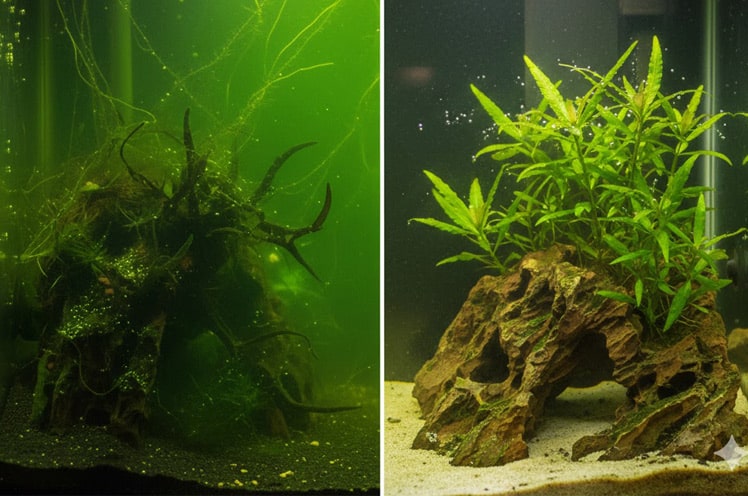
I don’t view algae as an enemy; I view it as a symptom. If your glass is covered in green film or your plants are being choked by hair algae, your ecosystem is sending you a message about a nutrient imbalance. After 15 years of fighting every bloom imaginable—from ‘Black Beard’ to ‘Blue-Green’ slime—in my 20-gallon long and 50-gallon community, I’ve learned that scrubbing harder isn’t the answer. In this guide, I’m sharing the 3-step ‘Algae Eradication Protocol’ I use to identify the root cause and clear your view for good.
Quick Guide: How to Fix Aquarium Algae Fast
If you’re in a rush, here is the quick breakdown of my Algae Eradication Protocol:
- Clean First: start with the glass, then gently rub or spot-treat algae on your plants, then scrub decor and rocks, then siphon the gravel, and finish with a 25% water change to clear the spores you stirred up.
- Best Tool: a magnetic scraper for the glass, since it lets you clean without turning off the filter first.
- For Algae on Plants: spot-treat with 3% Hydrogen Peroxide at 1ml per gallon, or prune off any leaf that’s more than half covered.
- The Common Root Cause: nitrates over 40ppm are essentially fertilizing the bloom, and during an active outbreak, cut your lighting timer down to 4 to 6 hours a day.
- The “Nuclear” Option: for severe Black Beard, hair algae, or Cyanobacteria blooms that haven’t responded to manual cleaning, a 72-hour total blackout wrapped in blankets kills most algae without chemicals, or go the chemical route if a blackout isn’t practical for you.
| Product Recommendations | Best For | Price | |
|---|---|---|---|
| Aqueon Algae Cleaning Magnet | Quick weekly glass maintenance | ~$13 | Check price |
| Green Killing Machine (UV Sterilizer) | Clearing free-floating algae and green water blooms | ~$40 | Check price |
| 3% Hydrogen Peroxide | Spot-treating stubborn Black Beard Algae | ~$3 | Check price |
| API AlgaeFix | Last-resort treatment for widespread hair algae | ~$5 | Check price |
| Seachem Flourish Excel | Daily prevention and spot-treating plant leaves | ~$10 | Check price |
Disclosure: AquaLogicHQ.com is a participant in the Amazon Services LLC Associates Program, as well as other affiliate programs, designed to provide a means for us to earn fees by linking to Amazon.com and affiliated sites at no extra cost to you. Please see the Affiliate Disclosure for more details.
How To Identify the Types of Algae in Your Aquarium
You can’t fix the problem until you know what it is. Over the years, I’ve learned that specific algae “types” tell a story about your water. I’m not an expert, but I have a lot of experience dealing with it.
| Algae Type | What it Looks Like | My Quick Diagnosis |
| Brown Algae (Diatoms) | Dusty brown coating | Diatom Bloom: Common in the first 3 months; fueled by silicates. |
| Green Spot Algae | Hard green dots on glass | Phosphate Imbalance. If it grows back in 3 days, your Phosphates are low. |
| Hair Algae | Long green strings | The “Light & Iron” Spike. Usually from excess light or over-fertilizing. |
| Black Beard (BBA) | Fuzzy black/grey tufts | CO2/Flow Issues. Check for “dead zones” where water isn’t moving. |
| Blue-Green Algae | Slimy green sheets | Low Nitrates. This is actually bacteria (Cyanobacteria). |
Quick Tip: Give it the “Smell Test.” If the algae has a strong, swampy, or metallic odor, it’s Blue-Green Algae. It thrives in low-flow areas and can be toxic to fish—handle it immediately.
How to Remove Aquarium Algae Easily (A 3-Step Protocol)
Step 1: Water Testing & Nutrient Balance
You can’t fix algae without knowing what it’s eating. Use your liquid test kit to check your nitrate levels immediately. If they are over 40ppm, you are essentially fertilizing the algae. Check out my guide on Lowering Fish Tank Nitrates Easily to starve the bloom at the source before you start scrubbing.
Step 2: The Manual Cleaning Process (Glass, Decor, and Plants)
Don’t jump straight to using chemicals. For a long-term fix, you need to remove as much algae as possible. This lowers the “bioload” and makes any further treatments twice as effective. Here is the order I usually follow to ensure I’m not just moving algae around the tank.
Scrape the Glass First
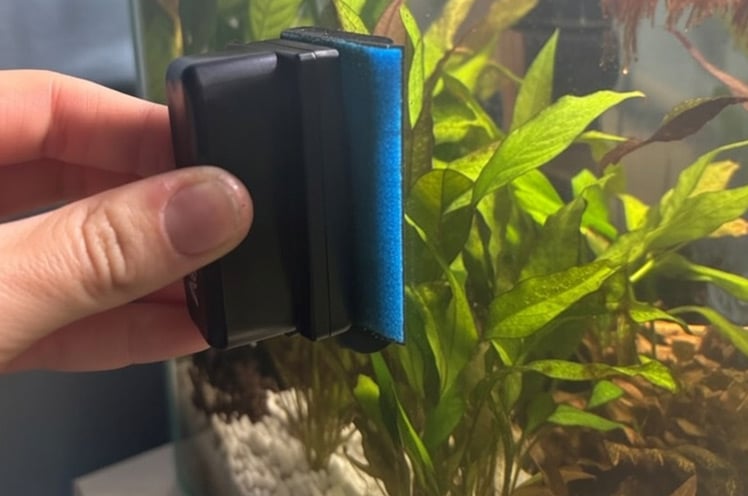
Use a magnetic scraper or even an old credit card to clean the glass before you turn off your filter. Keeping the filter running while you scrape allows the intake to catch the free-floating algae particles before they settle back down on your substrate or plants.
For years, I used an old credit card to scrape algae, and it works fine, but using a magnetic scraper is a game-changer.
How to Remove Algae from Aquarium Plants Safely
This is the part most people get wrong or skip over. You can’t scrub a leaf like you scrub a rock.
- The Gentle Rub: For broad-leaf plants like Anubias or Amazon Swords, gently rub the leaves between your thumb and forefinger.
- The Hydrogen Peroxide “Spot Treat”: If you have stubborn algae spots on your plants, turn off the filters so the water is still. Use 3% Hydrogen Peroxide directly onto the algae. Wait 5 minutes before turning the flow back on. For spot treatment, I use a small syringe I got on Amazon, and it makes it really easy.
- Strategic Pruning: If a leaf is more than 50% covered in hair algae or Black Beard Algae, it is likely dying. I like to use sharp aquascaping scissors to snip it off at the base. This saves the plant’s energy and stops the algae from spreading.
Deep Clean the Decor
Take out your large rocks, driftwood, and/or other tank ornaments. I like to scrub them in a bucket with a soft brush using my fish tank water. Never use straight tap water; the chlorine will destroy the beneficial nitrifying bacteria living on those surfaces.
For my large rocks with heavy algae growth, I use a dedicated stiff-bristled “algae brush,” and it seems to work best.
Siphon the Gravel At The Bottom (Substrate Cleaning)
Algae loves the “mulm” (this is the fish waste, uneaten food, and other stuff) that settles in your gravel or sand. Using a gravel vacuum to siphon the top layer of your substrate helps so much. Cleaning the gravel at the bottom of your tank helps to remove the phosphates and nitrates that are essentially “feeding” the algae bloom from the bottom up.
The Post-Clean Water Change
Once the cleaning is done, perform a 25% to 30% water change. This is the “final flush” that removes the microscopic spores you stirred up during the cleaning process.
Step 3: Lighting Adjustments & Boosting Filtration
Reducing light and getting the filter to work better (while boosting circulation) is going to do a lot to help clear up the situation.
- How I Reduce Lighting: I am lucky enough to have a great LED light with a timer and brightness settings, so I reduce the timer to only 4 to 6 hours of light per day. If your light doesn’t have a timer, aim for that same 4 to 6 hour window — even just unplugging it manually around the same time each day will get you most of the benefit.
- How I Boost Filtration: I clean out the filter housing and change filter media. Adding some filter floss to the filter helps quite a bit in getting the algae out of the tank. If the algae situation is really bad enough, I add another filter to the tank temporarily.
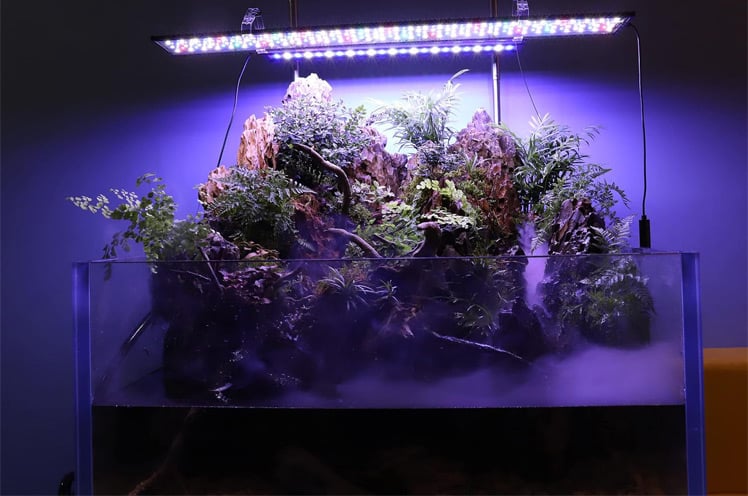
I see many beginners leave their lights on for 12 hours a day and wonder why their glass is green. If you’ve invested in a high-output aquarium light, you have to be even more careful. High intensity requires a logical schedule—if the light is too strong for your plant load, algae will win every time
The 72-Hour Blackout Hack for Severe Blooms
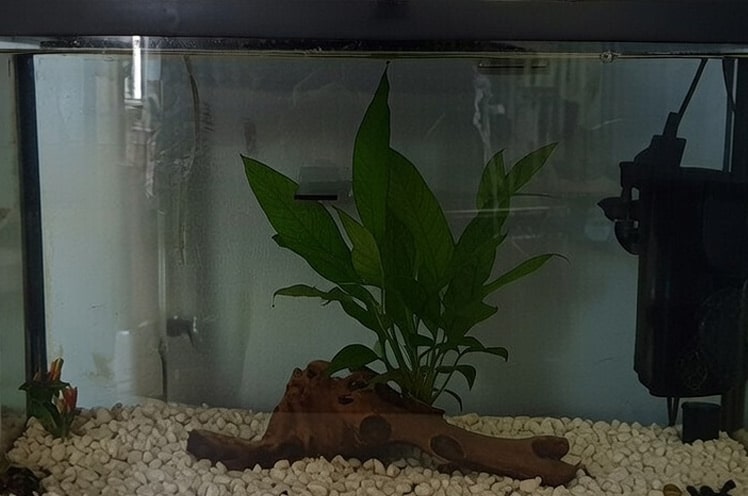
If you have a massive algae bloom, I recommend a total blackout. I have had to do this 3 or 4 times, and it really does help. Your fish will be fine in the dark; just make sure you can oxygenate the tank with an air pump.
Here is what has worked best for me:
- Turn off the tank lights and wrap the tank in a thick blanket, cardboard, or anything else that fully blocks light. No light should get in, including ambient light from windows or room lighting.
- Stop feeding your fish for the first 24 to 36 hours. Uneaten food breaks down into the same nutrients that feed the algae you’re trying to kill, so skipping a feeding or two during the blackout keeps you from undoing your own work.
- Important: You must run an airstone or bubbler during this time. As the algae dies, it consumes massive amounts of oxygen. Without extra bubbles, your fish could suffocate overnight.
Last Resort: The Chemical Option
If you tried cleaning, reducing light, boosting filtration, and a blackout, but nothing is working, dosing the right chemicals can help as a short-term fix. I cover my two go-to options, API AlgaeFix and Seachem Flourish Excel, just below.
How I use chemical algae killers: I add an airstone to begin boosting oxygenation. A lot of these chemicals reduce oxygen while killing algae. If there is any activated carbon in my filters, I remove it, because the carbon will stop the chemicals from working. Next, I dose the chemicals directly into the water. Then I watch the fish in the tank for any signs of stress or gasping.
What you can expect: For large algae blooms, you can expect it to take several days for the algae to die. You’ll notice that the algae changes color, and you’ll need to remove it from the tank.
Invertebrate Alert: If you have shrimp or snails, be extremely cautious with algaecides. Some can be harsh on species, so start with a half-dose to see how they react.
Best Tools and Chemicals That I Actually Use for Algae Removal (Products)
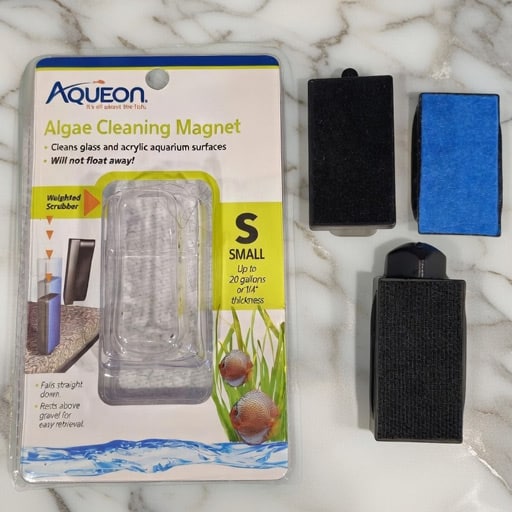
Aqueon Algae Cleaning Magnet:
Use the Aqueon algae cleaning magnet on the inside of an aquarium’s glass for quick cleaning. It’s the easiest way to keep your glass clear without getting your arms wet.
How I use it: I slide it across the glass whenever I notice or think I see algae. That’s it, pop it on, and clean!
Cost: Starting at about $13
4.6 Stars (17,185 Reviews)
The Green Killing Machine (UV Sterilizer):
An internal power filter that uses ultraviolet light to destroy the DNA of free-floating algae and pathogens.
How I use it: I drop this in from time to time when I see a growing algae bloom. It usually clears the water within 48 to 72 hours. UV sterilizers are a bit of a debated tool in the hobby — some hobbyists report a real dip in beneficial bacteria after running one, others don’t notice much effect at all. In my own tanks, I’ve had the best luck using it in short bursts rather than running it continuously, so I’d test your own water parameters afterward rather than assuming either outcome.
Cost: Starting at about $40
4.3 Stars (360 Reviews)
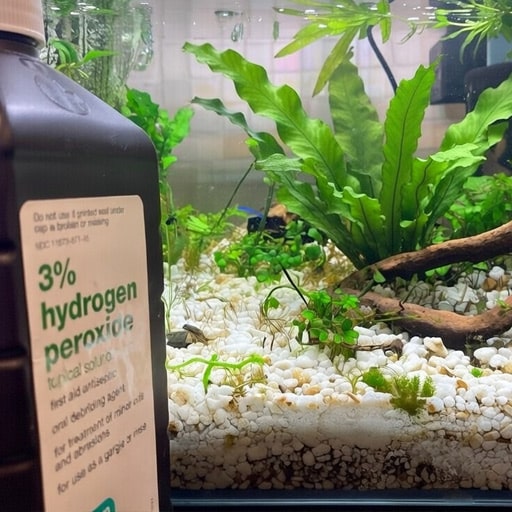
3% Hydrogen Peroxide:
A common household oxidizer that kills algae on contact and then safely breaks down into just water and oxygen
How I use it: I use a syringe to “spot treat” stubborn tufts of Black Beard Algae (BBA) directly. I turn off the filters and my air pump for 5 minutes so the peroxide stays on the target area.
You can get this stuff almost anywhere; it’s cheap and very effective!
Cost: Starting at about $3, depending on size
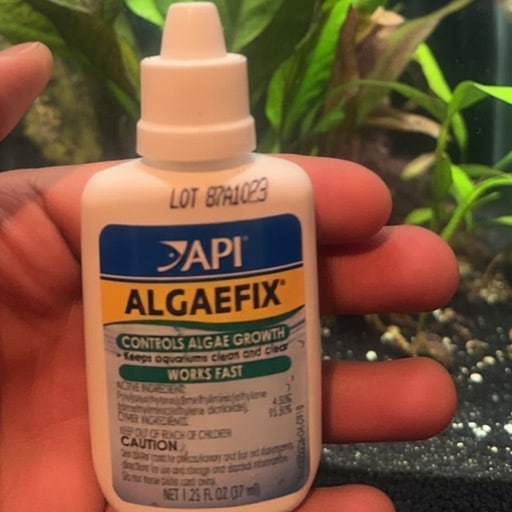
API AlgaeFix:
A specialized liquid algaecide designed to control many types of algae in freshwater aquariums.
How I use it: I use this as a last resort for widespread hair algae. I follow the dosing strictly and ensure I have extra aeration (like an airstone) running, as it can consume oxygen in the tank.
Cost: Starts at about $5
4.2 Stars (15,011 Reviews)
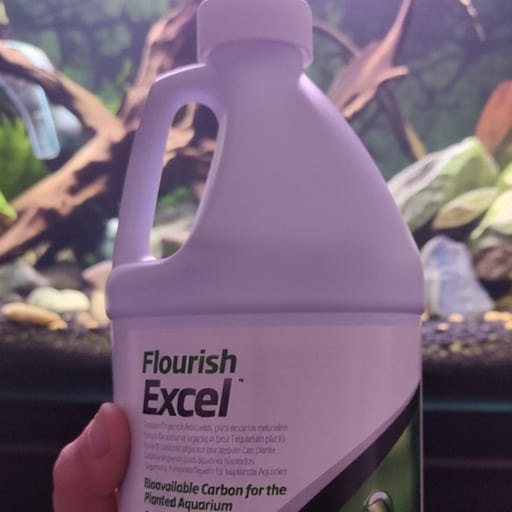
Seachem Flourish Excel:
Primarily a bioavailable organic carbon source for plants, but it has potent algaecidal properties.
How I use it: I dose this daily to give my plants a competitive edge over algae. Like peroxide, it’s also great for spot-treating algae growing on slow-growing plant leaves.
Cost: Starting at about $10
4.6 Stars (5,510 Reviews)
Important Note: Oxygen is Key. When using API AlgaeFix or Flourish Excel, keep your surface water moving. These treatments can cause a dip in oxygen levels, so aim your filter output up or turn on an airstone.
Aquarium Algae Removal FAQs
Will algae kill my fish?
Most algae are harmless. However, Cyanobacteria (Blue-Green) can produce genuine toxins (research confirms measurable effects on fish immune function), and a massive algae die-off can cause a dangerous oxygen crash if you don’t have enough surface agitation.
Why is my water turning green?
This is Volvox or suspended algae. It’s usually caused by direct sunlight hitting the tank or an ammonia spike. Check my Ammonia Guide to see if your cycle has crashed.
Can I use bleach to clean my tank?
I don’t recommend it. If even a trace of bleach remains, it’s game over for your fish. I prefer a 1:10 ratio of white vinegar to water for cleaning ornaments outside the tank.
How long should I leave my lights on?
I keep my 50-gallon community tank on a timer for 7 hours. If I see hair algae starting, I drop it to 6 hours until the balance returns. If a bloom is already established rather than just starting, go straight to the 4 to 6 hour range from Step 3 above — 6 hours is the right first move, not the full fix for an active outbreak.
How do I clean my filter without causing a bloom?
Only rinse one sponge or media tray at a time. If you clean the whole filter at once, you risk a mini-cycle, and the resulting ammonia spike will lead to an even bigger algae bloom.
Does Liquid Carbon actually kill algae?
Products like Excel are glutaraldehyde-based. They are mild algaecides. They work great for spot-treating, but they aren’t a permanent cure for poor maintenance.
Why is algae growing on my slow-growing plants?
Plants like Anubias grow slowly, making them easy targets. I move these plants to the shady areas of my 20-gallon long to keep them out of the direct light.
Can I use hydrogen peroxide (H2O2)?
Yes, it’s a great expert tool. I use 3% H2O2 in a syringe (1ml per gallon max). It’s highly effective but can be hard on sensitive mosses and shrimp, so use it sparingly.
Will a Water Change Pump help?
Yes! Making water changes easy means you’ll actually do them. Consistent 25% weekly changes are the best algae prevention there is. Check my water pump guide for my setup.
Is all algae bad?
Not at all! A little green fuzz on rocks can look natural and provide a grazing ground for shrimp and fry. I actually leave the back glass of my nano betta tank uncleaned for this very reason.
Final Thoughts: Building a Balanced Ecosystem
Winning the war on algae is about shifting your mindset from “killing” to “balancing.” In my 15 years, I’ve seen too many hobbyists give up because they couldn’t keep their glass clear. The logic is simple: algae is opportunistic. It fills the gaps that your plants or your maintenance routine leave behind.
Whether you’re dealing with a minor green haze or a total blackout-worthy bloom, don’t panic. Use the tools at your disposal—mechanical removal, light control, and chemical removers like AlgaeFix or Flourish Excel—to get the upper hand. But remember, the long-term victory comes from stability. Keep your water parameters in check, and stay on top of your water changes. Clear water isn’t a one-time event; it’s a result of a healthy system. Get the balance right, and the algae will have no choice but to disappear.
Which algae is currently driving you crazy? Let me know the color and where it’s growing in the comments below, and I’ll do what I can to help you troubleshoot it!

I founded AquaLogicHQ to share hands-on, tested strategies that come from 3-month algae battles and countless hours perfecting the nitrogen cycle. My mission is simple: I've made most of the mistakes on my four active tanks and am sharing the answers so you can avoid disaster in yours. When I’m not elbows-deep in a water change, I’m putting the latest hobby gear through its paces to see if it actually delivers.
- Best Canister Filters For Fish Tanks: What I’d Actually Buy for a Big Tank - July 26, 2026
- The Best Nano Aquarium Tanks I’ve Actually Run in My Fish Room - July 19, 2026
- The Best Fish Tank Heaters: Ranked and Sized for Your Setup - July 4, 2026